

By Geoff Folland The Future of Formation Part 3
In a recent conversation, a College academic described a decision that felt both obvious and costly. Enrolments in traditional ministry degrees were softening. Demand for counselling and chaplaincy has been rising. The balance sheet was tightening. The choice was whether to expand into new programs to stabilise revenue, or hold the line and accept increasing financial pressure.
That is not an isolated moment. It is becoming a pattern.
Across the nation, our theological colleges and ministry training systems are deliberately and intelligently adapting to a set of structural pressures that are clearly here to stay. We’re seeing a shift away from full-time residential pathways towards more part-time study, often alongside existing employment. Simultaneously, regulatory expectations are continually increasing. Compounding this, the ministry landscape itself is fragmenting into various, overlapping forms.
Far from being static, the system is in a state of sustained adjustment.
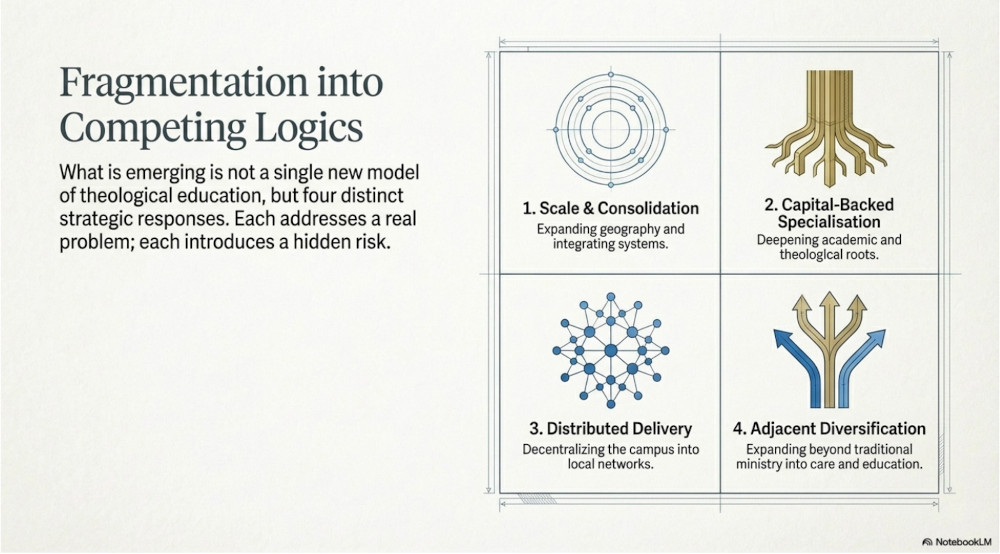
What is emerging is not a single new model of theological education, but a fragmentation into competing logics of formation, each addressing a real problem and introducing its own risks.

The Pressure Beneath the System
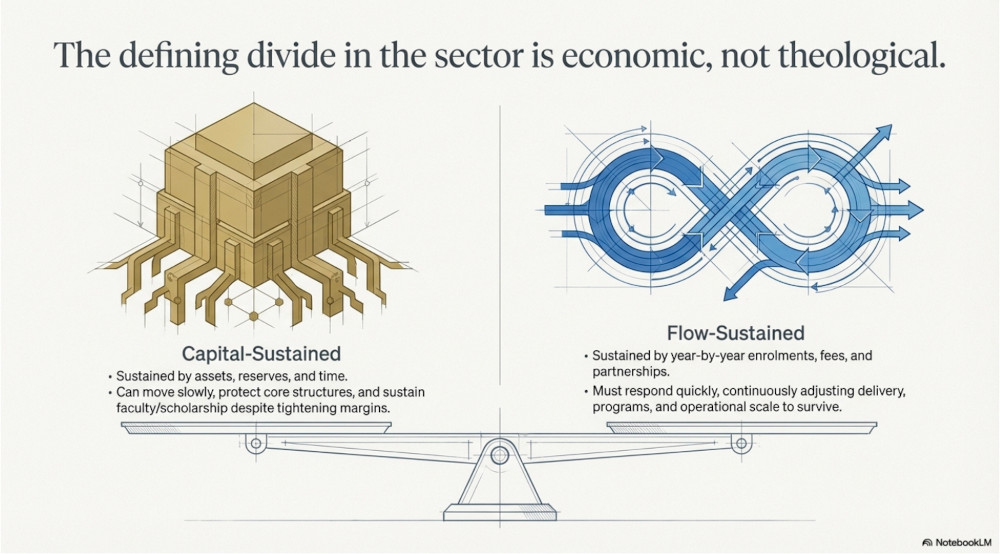
In the previous article, I argued that the defining divide in the sector is economic, not theological. Some institutions are sustained by capital: assets, reserves, and time. Others are sustained by flow: enrolments, fees, and partnerships that must hold year by year.
That distinction now shapes behaviour.
It explains why some institutions can move slowly, protecting core structures, while others must respond quickly, adjusting delivery, programs, or scale. It also explains why similar theological commitments can produce very different institutional strategies.
Once this becomes visible, the patterns of adaptation are easier to read.
1. Scale and Consolidation
One clear response to the pressures shaping the sector has been expansion.
This is not theoretical. It is already happening in concrete, traceable ways across multiple institutions.
Morling College has integrated Vose Seminary in Western Australia and Malyon College in Queensland, forming a national Baptist training platform. ACOM has consolidated with Stirling to form a “one national college” structure, while simultaneously launching the Stirling School of Community Care as a new vocational stream. Alphacrucis has extended further still, operating as a multi-disciplinary university college with national reach and a network of church-based delivery partnerships.
This is not a coincidence. It is a pattern.
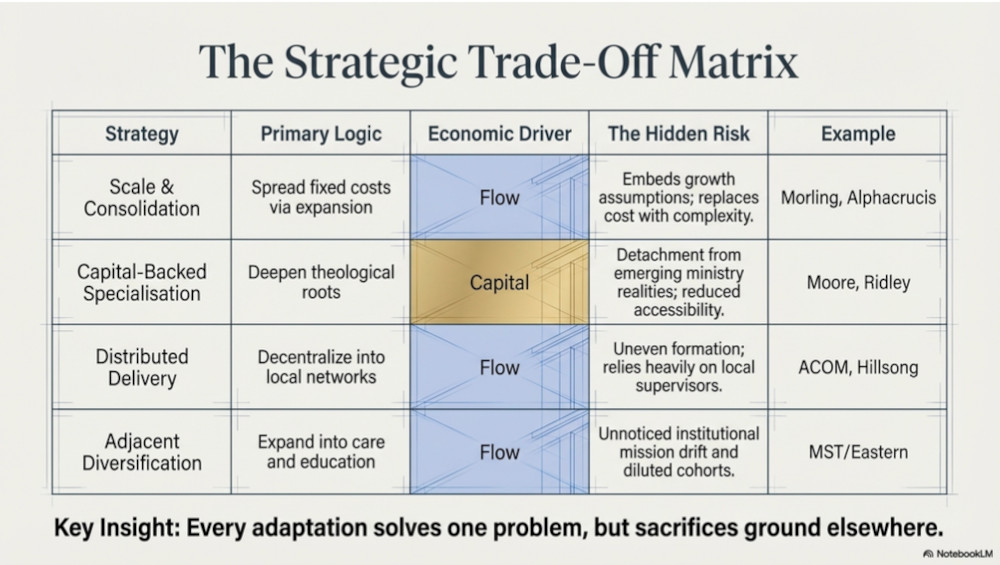
The logic behind it is straightforward. Scale allows institutions to spread fixed costs, extend their geographic reach, and access students who would not relocate for a traditional residential model. In a system where buildings, compliance, and staffing create a largely fixed cost base, expansion appears to offer a rational path forward.
A simple way to see this is at the administrative level.
Instead of three colleges each maintaining their own registrar, academic board, and compliance systems, a merged structure can centralise those functions. One system replaces three. In theory, this reduces duplication and improves efficiency.
But the numbers suggest a more complex reality.
Reach Australia alone is targeting 300 new churches and 750 leaders by 2030. That is a significant demand signal. It explains why institutions are scaling: the system expects more leaders, not fewer.
Yet scale does not remove pressure. It redistributes it.
Larger systems require coordination across multiple campuses, consistent enrolment flows, and increasingly complex governance structures. Growth assumptions become embedded in budgets. What looks like resilience can, under different conditions, become exposure. The question, then, is not whether scale works.
It is whether scale is actually lowering the cost of forming leaders—or simply building larger systems that carry the same underlying constraints.
At present, the evidence supports a more cautious conclusion.
Scale is an adaptive response.
But it is not, by itself, a solution.
2. Capital-backed Specialisation
A different response to the same pressures has been to deepen rather than expand.
Instead of building larger systems, some institutions have chosen to reinforce identity – academically, theologically, and institutionally – by strengthening balance sheets or more stable financial structures.
This is most clearly seen in colleges such as Moore, Ridley, and MST. These institutions have not pursued national scale in the same way as Morling or Alphacrucis. Instead, they have concentrated on maintaining continuity in faculty, investment in scholarship, and clarity of theological formation.
The economic foundation of this approach is not growth, but capital.
Moore College, for example, has total assets of approximately $87 million, providing a substantial buffer against short-term operating pressures. That level of capital changes behaviour. It allows leadership to make decisions over longer time horizons, absorb fluctuations in enrolment, and sustain faculty structures that would be difficult to maintain in a purely revenue-dependent model.
This is not simply financial strength. It is strategic optionality.
Institutions with capital can choose not to react immediately. They can preserve academic programs, retain experienced faculty, and continue investing in intellectual work even when margins tighten.
There is also a historical dimension to this model in Australia.
In Sydney, evangelical institutions did not respond to theological pressure from German liberal scholarship by withdrawing from academic engagement. They strengthened it. Moore College developed a model in which doctrinal clarity and serious academic work were held together rather than separated.
That legacy still shapes the system.
It explains why some institutions continue to prioritise research structures, faculty depth, and long-term theological contribution, even when those investments are not immediately efficient.
But capital-backed stability is not immunity. It buys time. It does not remove pressure.
As costs rise and the ministry landscape shifts, even well-resourced institutions face a sharper trade-off. Preserving academic depth and theological clarity may come at the cost of accessibility, flexibility, or alignment with emerging ministry pathways.
In practical terms, this can mean fewer entry points for second-career leaders, less integration with church-based training models, or slower adaptation to new forms of ministry.
The underlying question is not whether specialisation works. It clearly does.
The question is whether institutions built on capital and clarity can remain connected to the changing realities of ministry demand – or whether they risk becoming increasingly well-resourced and increasingly detached.
That tension is not yet resolved. But it is becoming more visible.
3. Distributed and Flexible Delivery
A third shift is reshaping the system more fundamentally. Not just how theological education is delivered—but where it is located.
ACOM explicitly outlines this model, asserting that student formation can effectively take place within their current ministry or workplace setting—the “campus” is their existing context. Alphacrucis adopts a similar strategy through its local church colleges, which combine online material, peer group learning, and mentorship embedded within church environments. The significant draw for a place like Hillsong College is the practical, hands-on experience of serving with elite practitioners on a worship team. Even institutions that were traditionally residential now offer flexible pathways, including on-campus, online, and intensive study modes.
The shift is not marginal. It is structural. The campus is no longer the centre of formation. It is one node in a broader network.
This change is driven by both demand and economics.
Students are increasingly older, part-time, and embedded in work or ministry contexts. The cost of relocating for full-time residential study has become prohibitive for many. At the same time, institutions are responding to the fixed-cost pressures inherent in maintaining physical campuses.
Distributed delivery addresses both constraints. A student can remain in their church. Keep their job. Study part-time. Formation comes to them.
There is a measurable logic to this shift. In one sense, it significantly expands the addressable market. It reaches bivocational leaders, second-career ministers, and those who would never enter a residential system. But it also changes the nature of formation itself.
Previously, formation was concentrated. Students shared a common life: lectures, meals, chapel, and informal conversations. The institution held together the intellectual, spiritual, and relational dimensions of training.
In a distributed model, that coherence is no longer guaranteed. It must be constructed. The responsibility shifts:
• from institution to network
• from shared environment to designed experience
• from proximity to intentionality
This introduces a different kind of risk. We are gaining flexibility. But we are placing greater weight on systems, mentors, and local contexts to carry what was previously embedded in community life.
The model works – particularly where strong local churches, capable supervisors, and intentional cohort structures are in place. But where those elements are weak or inconsistent, formation can become uneven. The system becomes scalable. But not necessarily uniform.
This is not a critique. It is a trade-off.
Distributed delivery aligns more closely with how ministry actually happens. It integrates learning and practice in real time. It lowers barriers to entry and broadens participation.
At the same time, it raises a more complex question. If formation is no longer anchored in a shared place, what ensures it remains coherent, deep, and transferable?
That question is now central to the system. And it does not yet have a settled answer.
4. Adjacent diversification
Alongside changes in scale and delivery, a fourth pattern is now firmly established. Institutions are expanding beyond traditional ministry degrees into adjacent vocational fields.
This is not speculative. It is already embedded in institutional strategy.
ACOM’s integration of Stirling included the launch of the Stirling School of Community Care, which was explicitly focused on counselling, chaplaincy, and related fields. Melbourne School of Theology took on Eastern College. Alphacrucis has expanded into education, business, and the creative arts as part of its university college model. Across the sector, similar moves are visible in counselling programs, chaplaincy training, and leadership degrees.
The pattern is consistent. When traditional ministry enrolments soften, institutions broaden their offering. The logic is both missional and economic.
On the demand side, the need is real. Job data and sector signals indicate sustained demand for chaplains in schools, aged care, and community settings, alongside ongoing recruitment across parachurch ministries and church networks. These are not peripheral roles. They are increasingly central to the expression of Christian presence in Australian society.
On the supply side, diversification stabilises revenue. A college that once depended primarily on ministry candidates can now draw from:
• counselling students
• education pathways
• leadership and community service roles
This broadens the student base and reduces reliance on a single vocational pipeline.
At one level, this is prudent stewardship. It allows institutions to remain viable while responding to genuine areas of need. It reflects a wider understanding of ministry that includes care, presence, and leadership beyond the local church.
But diversification is not neutral. It changes the internal logic of the institution. A simple illustration makes the point. A first-year theology cohort preparing for pastoral ministry operates differently from a mixed classroom that includes:
• a school chaplain in training
• a counsellor seeking accreditation
• a lay leader exploring theology part-time
The shared vocational trajectory that once shaped the classroom becomes less defined.
This is not necessarily a loss. It can enrich discussion and broaden perspective. But it does alter formation.
At an institutional level, the shift is more significant. As adjacent programs grow, they begin to influence:
• staffing decisions
• marketing priorities
• curriculum design
• resource allocation
Over time, the centre of gravity can move. The question is not whether counselling or chaplaincy is legitimate. They clearly are. The question is whether these programs remain integrated within a coherent theology of formation—or whether they gradually become parallel streams that subsidise the institution without being shaped by its original purpose.
This is now a governance issue. Boards are no longer simply overseeing a theological college. They are overseeing a portfolio. And portfolios require different disciplines:
• clarity of purpose
• boundaries between programs
• alignment between mission and revenue
Handled well, diversification strengthens both mission and sustainability.
Handled poorly, it creates drift—subtle, incremental, and often unnoticed until the institution no longer resembles what it was formed to be.
That tension is not theoretical. It is already present. And it will increasingly shape the next phase of the sector’s development.
The Parallel Formation Sector
While institutions are adapting, a parallel system has been strengthening alongside them.
In the evangelical ecosystem, this is visible through MTS, Reach Australia, and City to City Australia: structured pathways that identify, train, and deploy leaders through apprenticeships, residencies, and coaching frameworks. These are not informal initiatives; they are organised pipelines with defined stages and measurable outcomes.
In the Pentecostal ecosystem, similar dynamics are present, though expressed differently.
Programs such as C3 Launch, Planetshakers’ formation pathways, and ACC assessment processes operate as embedded systems of leadership development within local church contexts. They are typically cohort-based, relationally intensive, and closely aligned with church planting and team leadership.
Across both ecosystems, a significant shift is taking place.
Formation is becoming less linear.
The traditional sequence – study followed by ministry – is increasingly supplemented, and in some cases replaced, by pathways in which ministry experience precedes or runs alongside formal theological education. A reasonable reading of current patterns is that apprenticeship and church-based formation now function as primary filters for emerging leaders, with formal study integrated at different points rather than serving as the universal entry point.
The Changing Shape of Demand
At the same time, the demand side of the system is becoming more complex.
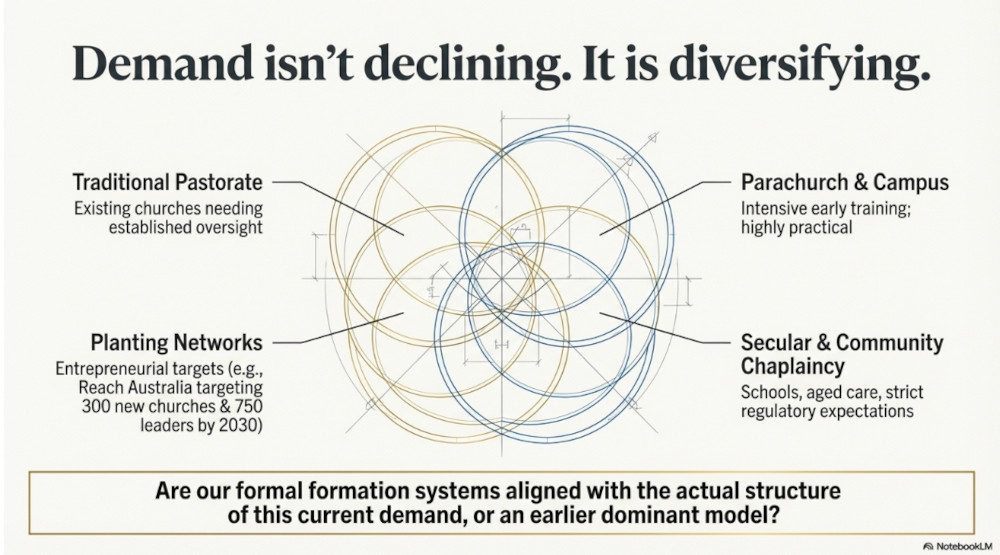
There is no single ministry labour market. There are multiple overlapping ones.
Existing churches continue to require pastors and assistants. Church planting networks are expanding, with explicit targets for new congregations and leaders. Chaplaincy roles in schools, aged care, and community settings are growing, driven in part by regulatory and societal expectations. Parachurch ministries—campus, youth, and mission organisations—form a substantial and often under-recognised workforce, recruiting early and training intensively.
In the Pentecostal sector, movement-level planting goals and leadership pipelines contribute to sustained demand for entrepreneurial and team-based leaders. In the evangelical sector, denominations and networks such as Reach Australia have articulated clear targets for church growth and leader development.
The evidence suggests that demand is not declining. It is diversifying.
But the pathways into these roles are no longer uniform. Some require formal theological degrees. Some integrate them within broader formation processes. Others prioritise leadership capacity, relational intelligence, and evangelistic effectiveness, with formal study playing a secondary or later role.
This resonates with my own journey. Power to Change initially provided me with a year-long, intensive training focused squarely on campus ministry skills—a highly practical approach, with some theological overlay. After about a decade on the ground, I saw the benefit of a formal theological education. This filled a vital academic gap for me; the original languages and deep exegesis were the real gold, honestly. Interestingly, the supposedly ‘practical’ units in that degree were far less applicable to our actual work.
This raises a necessary question, though it is too early to answer definitively. Are our formation systems aligned with the actual structure of demand, or are they still shaped by an earlier model of ministry that is no longer dominant?
The Intellectual Capital Question
This is where the longer-term implications begin to emerge.
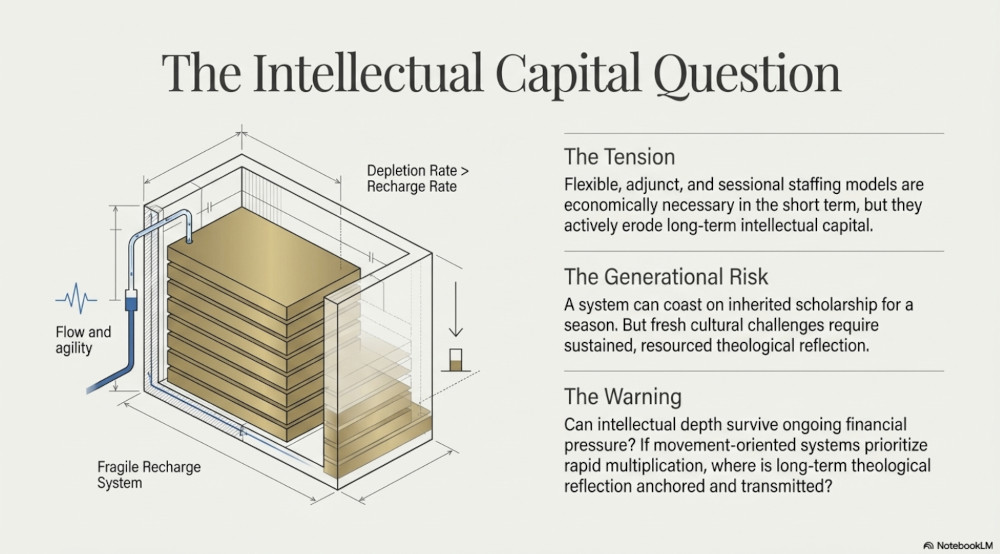
In parts of the Australian evangelical tradition, there has been a sustained commitment to theological scholarship—producing research, engaging with broader intellectual currents, and forming leaders capable of sustained reflection. That work depends on stable faculty structures, institutional investment, and time.
At the same time, there is increasing evidence across the sector of the use of more flexible staffing models, including adjunct and sessional teaching. These changes are often economically necessary and pedagogically effective in the short term.
In Pentecostal systems, the emphasis has historically been different. Formation is embedded in the life of the church, leadership development is closely tied to practice, and the priority is often multiplication rather than academic production.
These are not lesser priorities. They are different ones.
But they generate parallel questions.
In academically oriented systems, the question is whether intellectual depth can be sustained under ongoing financial pressure. In movement-oriented systems, the question is where long-term theological reflection is anchored, developed, and transmitted across generations.
A system can operate for some time on inherited intellectual capital, drawing on existing scholarship and external resources. But over time, new challenges emerge that require fresh theological work. The capacity to respond to those challenges depends on whether that work is being resourced and sustained.
The Underlying Tension
At this point, it would be easy to move toward strong conclusions. The evidence does not support that. What it does reveal is a set of tensions that are becoming more pronounced.
Institutions are adapting in ways that improve accessibility, broaden delivery, and increase alignment with ministry practice. At the same time, those adaptations redistribute rather than eliminate economic pressure, shift formation away from shared residential environments, and create a more fragmented set of pathways into ministry.
Across both evangelical and Pentecostal ecosystems, different models are emerging in response to similar constraints. The structures differ, the emphases vary, but the underlying pressures are shared.
At its core, the system is navigating a tension between flexibility and formation—between models that maximise access and responsiveness, and those that sustain depth, coherence, and long-term theological reflection.
Conclusion
The Australian theological formation system is not static. It is active, responsive, and, in many cases, remarkably creative.
Leaders are making difficult decisions under real constraints. Many of those decisions are thoughtful and necessary.
But adaptation is not neutral.
Every model solves one problem and introduces another.
The system is adapting. The question is whether it is adapting toward the future it actually needs—or away from it.
That is the question the next article will need to address directly.
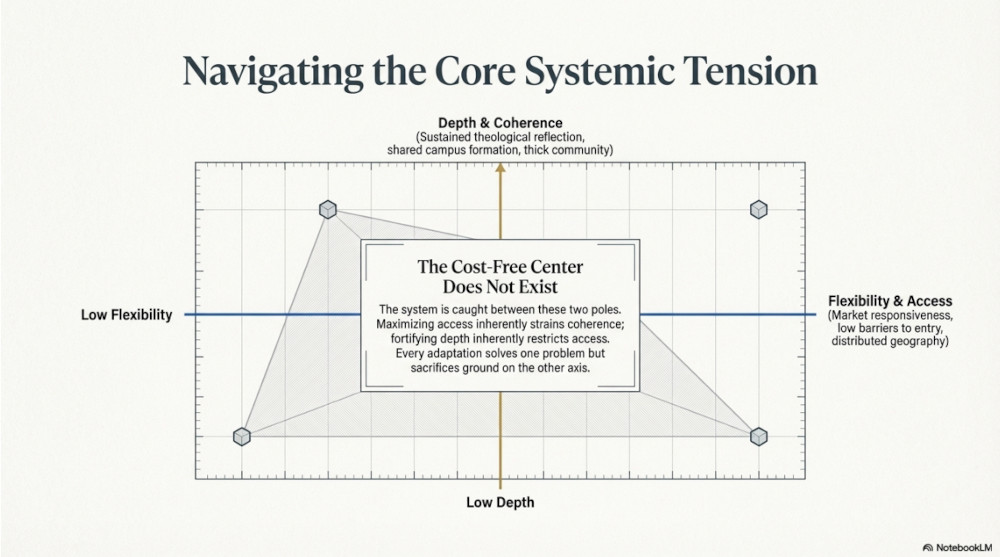
Image: Moore College in Newtown, Sydney
Thank you for a really well put together thesis and article John.
These are really helpful and thought-provoking articles
Thankyou