
Anzac Day, is still a day when many Australians cry out to God.
This morning at The Other Cheek’s local dawn service, in Burwood, NSW, we prayed, with local padre Monsignor Greg Flynn leading us in prayers for those remembering loved ones, those serving today in the defence forces, the people of New Zealand, and the people of Turkiye.
“O God our Father, hear the prayers of your people as we gather to plead for peace in our world. You, whose nature is peace, we thank and honour you for what you have given us. May we ever be reminded of the legacy of the courage, dedication and determination given to us by those who have served before us, and our sisters and brothers of New Zealand. As we remember this enduring friendship, we are reminded to strive after the same principles of peace, justice and freedom for all in our time. Through Christ our Lord, Amen.”
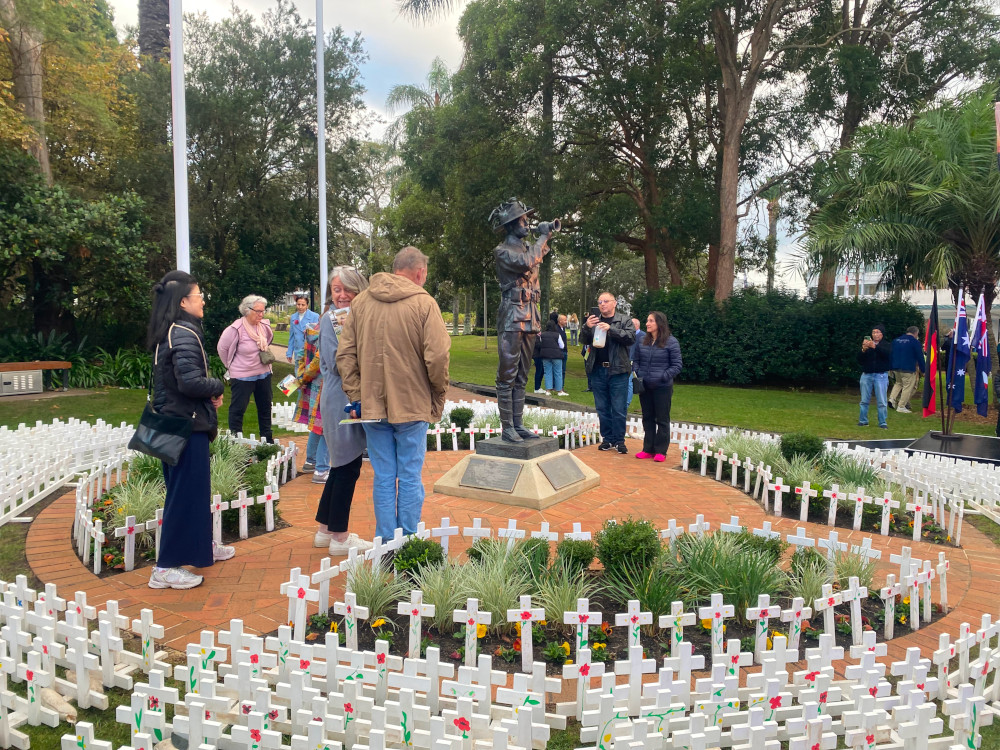
We were served by Australia’s largest all-female cadet corps from the MLC school. Canterbury Vale scouts had planted a field of crosses remembering the hundreds of names on the Burwood memorial arch.
We remembered a local hero, whose statue stood beside the platform.
From the commemorative booklet and Burwood Mayor John Faker’s speech: Leonard Francis Hall was born in Burwood on 9 May 1897 and was part of the celebrated 10th Light Horse Regiment, which included some of the best riders in the world.
Underage, Hall enlisted in the First Australian Imperial Force in 1915 after the Major of the Light Horse Regiment heard him play the bugle and begged him to join as their regiment did not have a bugler.
As Hall boarded the boat to the Great War with his bugle in hand, that he would not play again, he plucked an emu plume from his slouch hat and placed it into the hands of a girl waving in the crowd.
When Hall landed at Gallipoli in the former Ottoman Empire he was the lead machine-gunner in the impossible assault of the Battle of Nek. This was the worst battle of the Gallipoli campaign with 879 of his fellow diggers killed.
After evacuating the Gallipoli Peninsula, Hal fought in the Battle of Beersheba in Ottoman Syria in 1917 where he was injured by a bomb which killed nine out of his 14-man crew and his horse, Q6.
The courage he exhibited during this campaign saw him picked by Thomas Edward Lawrence (Lawrence of Arabia) to help the British Empire in the Capture of Damascus in 1918.
Hall returned to Australia in 1919 and was met by a woman who said, “Excuse me sir, would you like your plume back?” Hall married his feather caretaker, Eunice, two years later, and they had two children. Hall’s grandaughter Karen and great-granddaughter Madison, a reservist, attended this year’s service, a powerful reminder of the Anzac spirit across generations.
Leonard Francis Hall died in Perth on 24 February 1999, aged 101 years, after living a life of perseverance, strength and heroism.
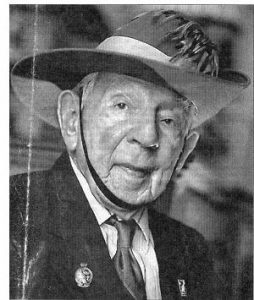
A Lighthorse Association profile states, “Hall bore no grudges against his foe. Revisiting Gallipoli in 1990 for the 75th anniversary, he told [Jonathan King] ‘I had nothing against the Turks. They are good people. I respect them.
‘They were just defending their home ground. In fact,
I would fight for them next time rather than fight against them.’”