
A controversy rippling through what some commentators call the “reformed Internet” pits Presbyterians in the US PCA against each other. The Presbyterian Church IN America is somewhat similar to the Presbyterian Church OF Australia, with both holding to the Westminster Confession of Faith (WCF) as their doctrinal standards, both complementarian (teaching elders are male), and both theologically conservative.
But a recent controversy over a minister in the US PCA arguing that the abolitionist cause for ending slavery in the US was wrong was somewhat of a shock to this writer.
It began with a Twitter exchange between Zachary Garris, a PCA minister from New Mexico, and Lamont English, a director with the PCA’s missionary arm, Mission to the World.
Here’s part of their conversation on X.


In response, a letter from some sixty PCA ministers called for Garris to be investigated by his presbytery (a region, similar to an Anglican diocese but without Bishops), as reported by conservative commentator Jon Harris. Another letter stated that Garris was out of step with the WCF. The outcome was that Garris was suspended, but not for his comments about slavery, but for “corrupt speech” over another exchange on Twitter.
It sounds a bit like how the Feds sent Al Capone to prison for tax evasion, not murder.
This writer can’t see inside the PCA investigators’ thinking, but it smacks of compromise – we are uneasy about taking Garris on over slavery, but we can find another way to punish him.
Garris apologised for being insufficiently clear, stated that “man stealing” was condemned in the Bible, and that “I think it was good and proper and Godly for American Christians living with the realities of their times to seek to end the slave system as a whole….”
So what did he mean in the original discussion when he said he agreed with the “majority of American Presbyterians” who “opposed slavery and wanted to get rid of slavery, but they rejected abolitionism because of the Bible’s teaching”?
The PCA committee that investigated Garris concluded, “From this interaction, to the question of whether American chattel slavery was absolutely sinful, we deduce that TE Garris’ assertion was no, it was not absolutely sinful. [“…As for the 2nd question (about American chattel slavery), the majority of American Presbyterians said no…” “…I just told you the position of most Presbyterians, with which I agree.”] However, the answer to Mr. English’s question is, according to our standards, straightforward [cf. WLC 142: “The sins forbidden in the eighth commandment…are, theft, robbery, manstealing, and receiving anything that is stolen…”]. It could have been answered clearly with reference to numerous Bible passages such [as] 1 Tim 1:10, Prov. 29:24, Psalm 50:16, 18 (as well as the first assertion of the statement on Racial Reconciliation: “…the heinous sins attendant with unbiblical forms of servitude-including oppression, racism, exploitation, manstealing, and chattel slavery – stand in opposition to the Gospel…”).
Garris’ unwillingness to support the abolitionists’ view of slavery – that it should be immediately and totally abolished because it is morally wrong – is because he believes the slavery described in the Bible contains chattel slavery, and so he does not wish to go against the Bible. He apparently thought abuses could be ameliorated, and ending the system could be gradual, or that some forms of slavery were fine. To this writer, he raises a live issue about the Bible – for example, the ancient Israelites were allowed to seize slaves from other nations, and at other times were told to put captives to death. In opposing slavery, Christians have to come to a point of view about the slavery practised in ancient Israel in the Bible accounts.
But the PCA has moved away from Garris’ position with its Statement on Racial Reconciliation quoted above.
This writer is reminded of historian John Dickson’s frequent use of a “lighting a fuse” analogy to describe how the Apostle Paul dealt with Roman slavery in the book of Philemon, famously stating that Paul “lit a fuse that would eventually blow up the institution.”
Garris identifies as a Christian Nationalist, and this debate has been held as an example of a cultural divide in the US’s PCA denomination.
One theory of a divide is outlined in this podcast by PCA pastor Matthew Everhard. He contrasts a “big tent” group with a “confessional conservative” position, which labelling probably indicates his bias.
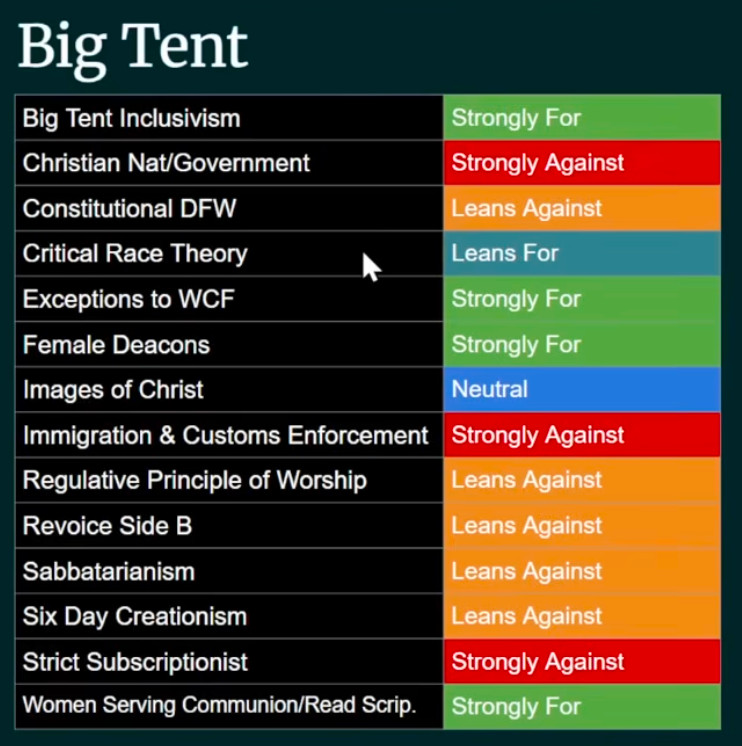
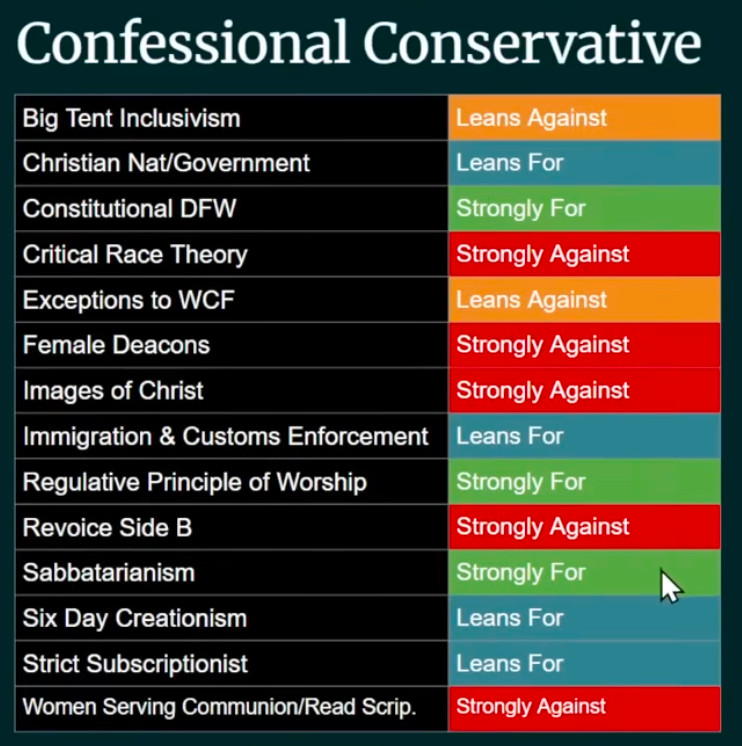
Some of these topics, a range of views on six-day creationism, for example, are common to many evangelical churches, certainly among lay people. DFW means a directory for public worship, a prayerbook-type issue. But others, Christian Government (usually called Christian nationalism, crudely put, the idea that Christians should dominate), critical race theory, and Immigration are political issues. (In the case of critical race theory, it is the application of the theories that is certainly political, including special provisions for minorities.)
Behind the controversy over Garris’ views on slavery lies a possible divide within a church over political issues. The inclusion of political issues on a church’s agenda, whether one leans right or left politically, is fraught with danger.
The US PCA is alert to a growing need to tackle the topic of Christian nationalism, which can be linked to each of the political issues Everhard listed, and has established a study committee.
Last week, the Study Committee issued a “partial report,” in the form of a pastoral letter. They believe they need a year to continue their work.
They commend the growing interest in Christian civil duty to engage with society, but issue two warnings that happen to relate to the Garris cases’ mix of concern about language and race.
On language, “We cannot help but be alarmed by the intemperate and unclean speech adopted by some of those who call themselves Christian Nationalists. We wish to remind the officers and members of the Presbyterian Church in America that whatever form our political theology may take, and however urgent the perceived problems and crises facing the nation may be, nothing can justify ungodliness in speech, or in conduct. It is sometimes suggested that there is a crisis of masculinity in contemporary America and that much that ails our society in both church and state is a result of the pervasive feminisation of our culture. Indeed, we regard with dismay a widespread confusion—if not the complete rejection—in many sections of our society of the basic biblical binary that identifies humanity in the image of God as immutably male and female. Yet whatever solutions Christians may offer to these challenges, whether real or perceived, crass language, unclean speech, and disdain for the good name of our neighbours must not be excused. The Bible tells us to avoid irreverent babble (2 Tim. 2:16) and foolish, ignorant controversies (v. 23). The Lord’s servant must not be quarrelsome, but kind to everyone (v. 24), and when correction is necessary, it should be carried out with gentleness 1 (v. 25).
And on race: “we wish to warn the members and officers of the Presbyterian Church in America of some expressions of what is called Christian Nationalism that embrace forms of antisemitism, race realism, and Kinism. Under the guise of conservative Christian political discourse, some advocate for the segregation of different ethnicities and cultures, and believe that the Bible teaches a view of ‘nations’ that treats cultural and ethnic pluralism as contrary to biblical teaching. The PCA has repeatedly and unequivocally declared its repudiation of these views as incompatible with biblical Christianity, and the courts of the church are urged to ensure that no place in their ranks be given to them.”
Note: Race realism (in the conservative right as distinct from critical theory) is an idea that, instead of striving for ideals of racial equality, marginalised groups should focus on pragmatic strategies (such as community power, equity, and direct representation) to make life bearable.
The PCA has tackled the question of Christian Nationalism earlier than other churches. But it is an issue that will arrive at all evangelical churches sooner rather than later.
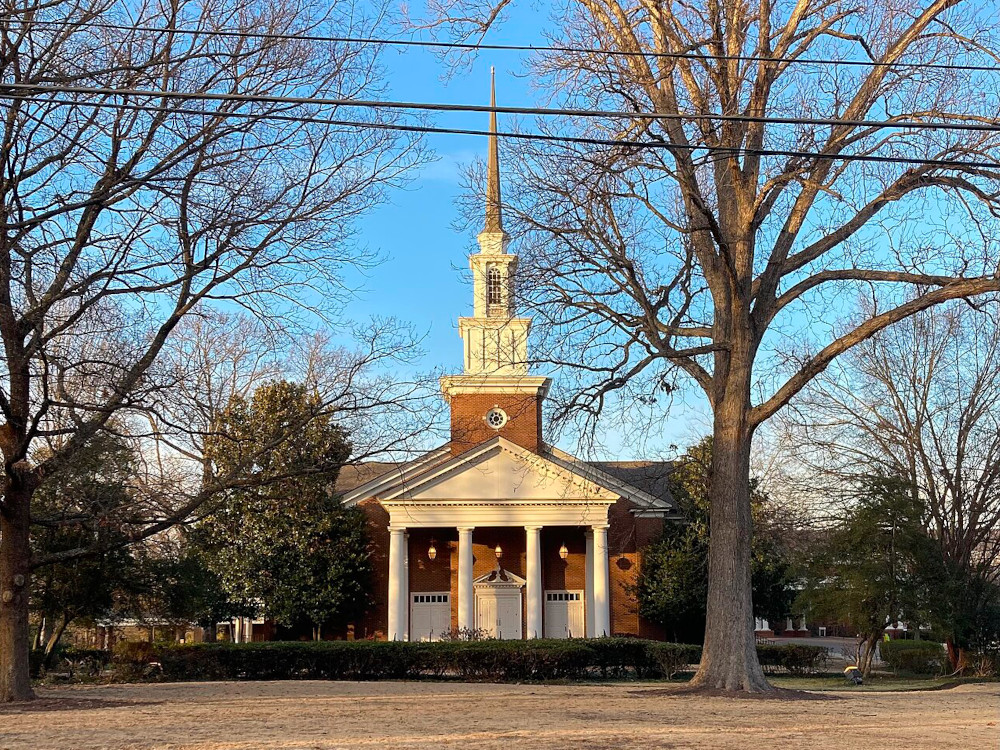
Image: Independent Presbyterian Church, Memphis, is a PCA church originally founded by people who wanted segregated worship. Image Credit: Dclemens1971 / Wikipedia