
“The Gobal Hope report”:” from Tearfund, bused on a survey by NCLS research has found that the level of Hope held by Australians has fallen.
Three key findings of the report are
• Hope is on the decline in Australia
• More Australians are now concerned about political instability, war, and economic insecurity
• Young people are concerned for their futures
But there are positives
• Australians feel more hopeful about the future closer to home
• Faith, connection, and action are catalysts for hope.
Ruth Powell, director of NCLS Reseach, defined hope in a webinar that introduced the report: “Speaker 3 (09:04):
“Hope is more than a feeling. It is the belief that even when things are wrong, that it’s not the end of the story. It is accompanied by imagination and creativity. Hope is action oriented. It’s something we do hope is positive, but it’s focused on goals and ways to achieve them. Hope is a commitment to act in a world whose future remains uncertain.
“Hope is the certainty that something is worth doing no matter how it turns out. It’s a skill that can be learned and I will be touching on some Christian perspectives. This is a webinar that is open to everybody. I suspect many of you are from a Christian background, but we are aware that Christian hope is a particular flavour as well. And I guess hope is from a Christian perspective, a decision that Christians are called to make as partners in God’s redeeming work in the world.”
It turns out that the precise moment in human history that the Hope questions were asked of Australians was imprtant. 2025 results were different than 2024.
“
If you imagine a spectrum of hope, the weight of the Australian community is currently tipped to the low not hopeful end, Ruth Powell told the webinar. :For example, when we asked how hopeful they were about the future of the world, 44% of Australians were low in hope. They said not at all or only a little hope. Only 19% of Australians that’s less than one in five reported feeling hopeful or very hopeful. In the words of our respondents, the way the world is moving, it’s very hard to be hopeful.”
The state of the world is having an impact. “Political instability and increasing conflicts are causing many nations
to look inward in acts of self-protectionism, Tearfund CEO, Bec Oates writes in the report. “Meanwhile, we’re seeing the effects of climate change increase across the globe and here at home. As the findings of this research show, these challenges are leaving Australians feeling less hopeful about the state of the world than in years before.
“And yet, as people of God, we are people of hope. In the midst of these growing concerns, we have a unique opportunity to embody hope within Australia and our world.”
NCLS’s Ruth Powell in the webinar introducing the report pointed to other key findings – that community activity such as volunteering increases hope as does spiritual beliefs.
The report finds the hope has declined in Australia. “In 2025, only 18% of Australians reported feeling ‘hopeful’ or ‘very hopeful’ about the future of the world. This marks a notable decline from 2024 in which 24% of Australians said they were ‘hopeful’ or ‘very hopeful’ about the future of the world in 2024.”
And the driver for change? Global instability and conflict are increasingly factors in the lack of hope among Australians.
“Political instability and economic insecurity saw the sharpest increases in 2025 – political instability jumped from 17% in 2024 to 29% in 2025,” according to the report.
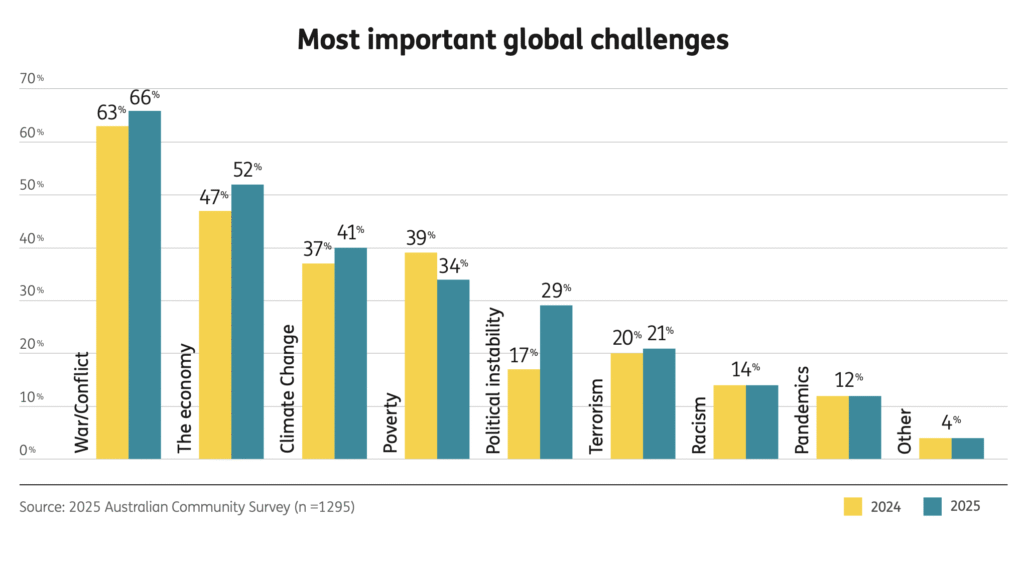
However the ranking of concerns varied by age group. “Younger Australians were the most concerned about climate change and its impact on their futures of any age group – roughly 8 in 10 Australians aged 18-34 years were at least ‘moderately concerned’ about climate change compared to 5 in 10 people 65+ years.
“Similarly, the number of Australians who were ‘not at all concerned’ about climate change increased with age – 9% of 18-34 year olds were not concerned at all about climate change while 34% of 65+ year-olds said they had no concern about climate change and the future.”
One repondent quoted in the report said “I’m hopeful for my future because I know whether it’s big or small, I can do something good,” reflecting a rise in hope for issues close to home.
Religion was seen to impact hope. “Christian rhythms like church attendance and regular prayer also contribute to higher levels of hope,” the report notes. “For example, about 33% of people who were ‘hopeful’ or ‘very hopeful’ about the future attend church at least once a month, compared to 15% of those with no religious beliefs.”
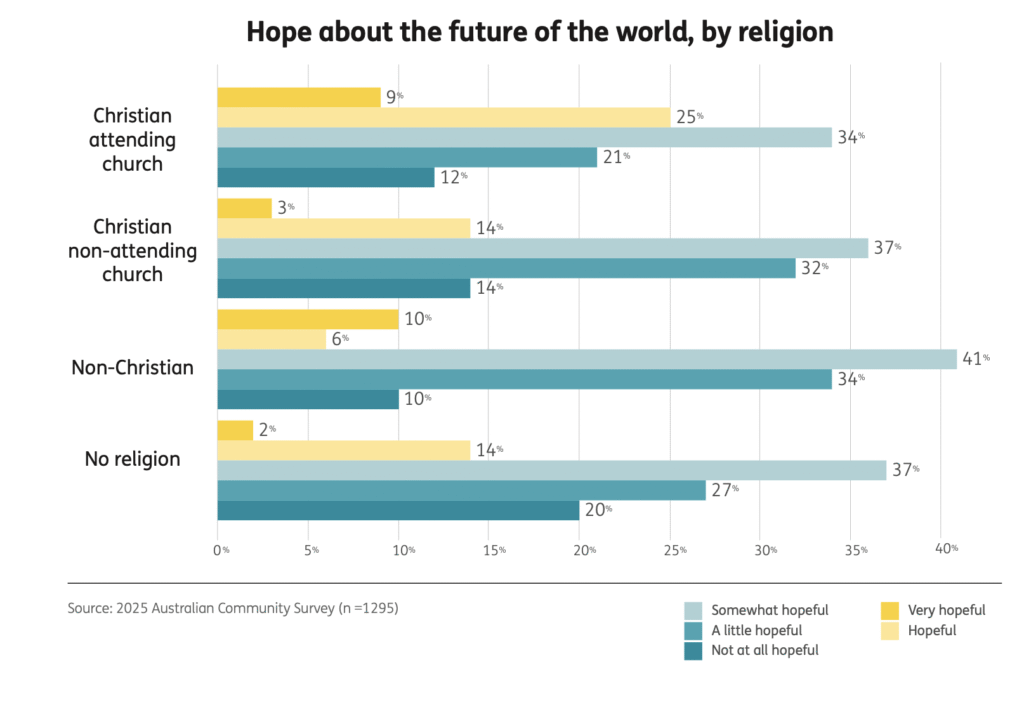
“People who have faith and who practise their faith through regular prayer and attending religious services have higher levels of hope for the future of the world, their communities and their personal future,” Powell told the webinar. ” “50% of those who identify as neither religious or spiritual were a little or not at all hopeful about the future of the world. And only 14% were hopeful or very hopeful. In contrast, over a quarter of Australians who identify as religious and spiritual, were hopeful or very hopeful about the future of the world. And the same pattern recurs when you’re considering personal futures, religious and spiritual people are more likely to be hopeful.”
In contrast to faith, gender and level of education were not factors in hope according to NCLS Research diurector Powell. “We looked for clues about who the most hopeful Australians are. So who do you think is more hopeful if we think about demographic profile of Australians? Which groups of Australians are most hopeful? Do you think women or men are most hopeful? If I had a poll, I’d get you to answer it right now, but have your answer locked in, is it women or men or neither? What we discovered is that in general, men and women have similar levels of hope. There are some variations along the way, but in fact gender is not something that distinguishes levels of hope. What about education? Do you think that someone who has completed a university degree is more or less likely to be hopeful than someone who’s completed a certificate or diploma or has finished up to year 12? Does education make a difference to your levels of hope? Our research says it doesn’t really make any difference. “