
Charles Brammall: From Sculpture to Sirens: Church, and Love’s Holiness
My lovely, nearly 80-year-old cousin is Jewish. She grew up Protestant, then married a lovely Jewish chap, and converted. They have raised their three children as Jews- it is inherited through the Mum. They have friends in Israel whose children are fighting in Gaza. A worrying time- the fear is constant. This is not ideology— it is parents waiting by phones, watching news feeds, trying to sleep.
* * * *
My memories of Bondi are fond. With a frisson of intrigue, and now sorrow. Sunday, the first Sunday of Hanukkah, at Bondi was awful. Hellish, Indescribable.
I worked for a time at Sculpture by the Sea as Volunteer Manager. Every October, the suburb settles into a familiar rhythm with Sculptures stretched along the cliffs, headlands, and beach. It is already beautiful, but then the art pops up, and things feel alive, intimate, communicative.
Sometimes we would arrive at Sculptures first thing to start work, and discover unapproved “feral” sculptures. They had been guerrilla-ed in overnight and mounted on plinths by their cranky sculptors whose works hadn’t been chosen. Free publicity and the desire to be recognised.
Some of the ferals were far better than the genuine ones. Some were dreadful. (But then, some of the genuine ones were dreadful too.) In the past, my family were annual devotees, but our enthusiasm has waned as more and more of the works have become bigger, amorphous, colourless, carved marble blobs.
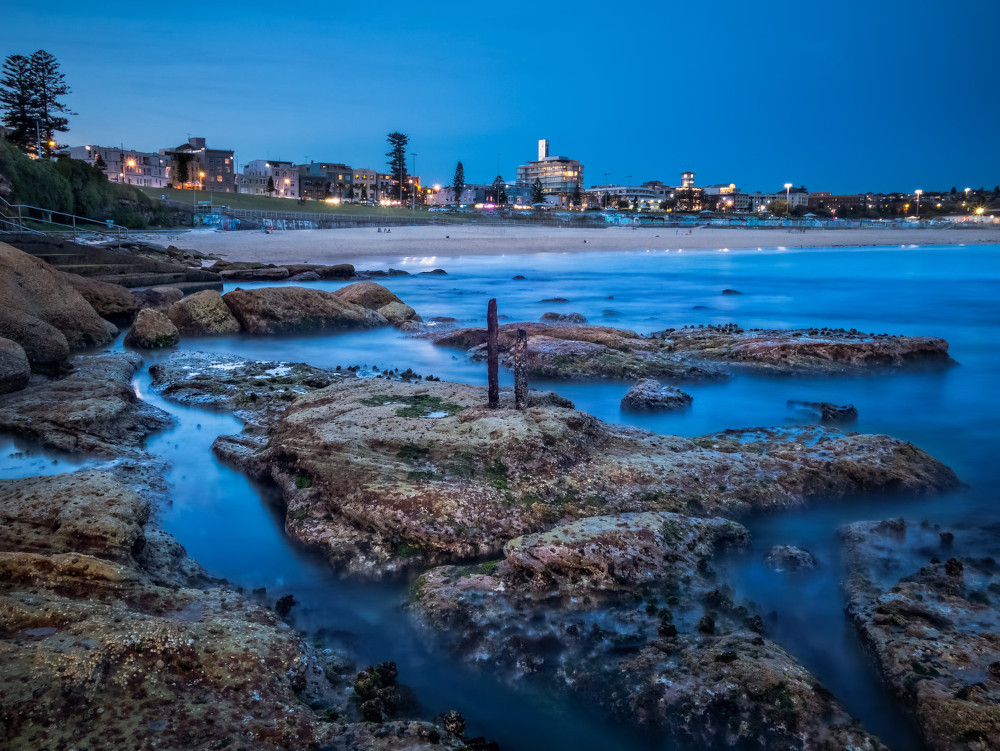
Bondi is usually a relaxed, curious, and quiet town- exactly where it wants to be. Families meander, kids weep as their ice creams fall off cones onto red-hot bitumen; couples canoodle and clasp hands. The ocean parps below, steadfast, at times wild, at others, soporific. Everything seems safe, ordered, unshakable.
People take their time, and prams roll past dogs galloping past prams. Older couples stop to read sculpture plaques while kids argue over lollies like the sky was falling. Tourists try to interpret the art, and friends debate it. And below it all, the waves keep their irregular rhythm, capriciously constant, reminding us that some things don’t change.
Those October days are almost too perfect to be true. They lodge in our memory because nothing can ever interrupt them.
But then Sunday that week- brutally stark contrast. Horror arrived in a father-son team, and it didn’t just interrupt Bondi— it contradicted it, shrank and imploded it.
Bondi is meant to feel safe. People come here to show visitors that Aussie life can be bronzed and good. Can be ordinary and beautiful. And that rest is allowed. Apart from the beach and surf, trying to claim many visitors, especially non-English-speaking, as evidenced by TV’s popular “Bondi Rescue”.
Because it doesn’t take too much for Bondi to be cracked. On Sunday, terror landed here, all the way from Campsie, Bonnyrigg and the Philippines. It landed suddenly and violently on streets, footbridges we’ve crossed 100 times, and footpaths we’ve always taken for granted.
After it happened, Bondi Anglican, with Snr Minister Martin Morgan leading quietly and steadily, became a place for people to land their grief. As church was just finishing, people ran past, terrified, and Martin immediately detected tragedy. People sprinted through the doors asking, gratefully sheltering.
There were no slogans or grandstanding coming from St Andrew’s, just open doors, kettles on, and chairs ready. Clergy and laypeople walked alongside families, shop owners, and Jewish people; horrified Muslim people, police and emergency workers- just being present without fuss.
They prayed and read scripture if asked, stayed silent when words failed, and offered something sometimes more precious than speech- sitting with other humans, sometimes holding them, silent. Letting the community hyperventilate, then breathe and begin the long, long, lifelong journey of process, in a safe space. It was Word ministry in its most necessary, human, form.
I know it because I’ve lived inside it. Years ago, when I and all my belongings were permanently ejected, literally onto the footpath, the same Morgans took me in without hesitation. No interrogation, no awkwardness, just a home, a space, and a family who knew how to carry someone without making them feel weird or weak.
I stayed for months and learned what ha ealthy family actually looks like. Chatting, watching TV, and physical affection. Hanging together on the lounge, reclining on each other, time off. Guffawing, knocking each other in unforced, unplanned fun. Relieved tension. They showed me that life could feel joyous and steady, not always sorrowful. That it could feel un-guilty, human, full, even after being emptied and hollowed out utterly.
During that season, I split my time. I stayed with the Morgans half the week while working at Sculpture by the Sea, then with friends in Lane Cove while tutoring over that side. I was learning how to exist in the world again, slowly, timidly.
Sculpture by the Sea was work, but also its own strange, absorbing world. One day, I discovered an elderly lady “jumper”, a sculptor, sitting right on the cliff’s edge. She was like a foundling bird, about to take its first flight, feet dangling dangerously over the edge, threatening to make it her last flight. I sat with her, chatted, and sent for a coffee. Held her hand, and stayed until the negotiators arrived. That memory sticks, heavy, and humbling.
Bondi can be glossy, playful, sometimes absurd, but never shallow. Other days at the beach were ordinary, hilarious. Once we tried to find an alleged restaurant called “Miss-Chu”, and drove round and round in circles for ages, getting more and more hangry, finally giving up in tears of laughter. The search itself had become its own small Bondi odyssey.
For a time, I tutored primary kids there for a small agency. One day, I made the trip all the way over from Lane Cove, and my (slightly dodgy) employer wasn’t there; everything was locked up and empty. I never saw nor heard of him again, and never did get paid.
Another time, we parked next to a gleaming, pricey, sleek muscle car and went to the beach. We returned to find a group of enormous foreign men surrounding us. The scariest one explained threateningly that I’d scratched his girlfriend’s car. My body flooded with adrenaline— fight, flight, freeze?
I was terrified, but fought, and said, “No I didn’t!” He opened my back door, and my heart sank as the edge of my door perfectly matched the scratch on his. He said, “You know I’m gonna have to get the whole car resprayed because of you. And you’re gonna pay.” After arguing and negotiating, we agreed to split the cost of respraying just the door. I walked away shaken, but alive, grateful for the lesson in fear, courage and Bondi car parks.
Bondi also has its quieter moments. I once had brekkie with a friend at a cafe by the beach, and she had a “fruit compote”, my first encounter with one. Bondi can be mundane and extraordinary at the same time, ordinary and yet capable of lodging memories you carry forever.
And it has always been a collision point- anonymity meets fame (it’s a little like star spotting in Hollywood). I have run into Chris Lilley, Noah Taylor, James Packer, Chanel 9’s David Gyngell, and TV vet Dr Chris Brown- he of the impossibly square jaw and Chesty Bond’s looks. His practice is there, and punters regularly stroll in for autographs and selfies. And remember the time Packer and Gyngell had a punch-up on the footpath there?
Wealth meets weariness in Bondi- glamour, exhaustion, confidence and chaos. All mixed in. Orthodox Hasidic Jews with sideburns, beards, phylacteries and black hats, vs. toplessness.
Bondi is also home to the multicoloured streetscape, reminiscent of the rows of beach huts in Brighton, Vic.
South of the sewer outlet was topless or nude; North of it pretended not to notice, but did, and enjoyed it. Chaos, all mixed up delightfully.
Now the whole place feels metaphorically topless…
Relaxed almost to recklessness, unapologetic in exposure, Bondi is proud of itself. It’s also home to a bakery that, in this author’s opinion, makes the best sausage rolls in the world. Also to Israeli halva that permanently recalibrates your taste expectations. Greek halva is fine, Turkish halva is meh, but Israeli halva has that dense, sweet, tinily bitter thing happening that you can only get in Jewish delis here.
That cultural overlap comes with a cost. Nearby, in Queen’s Park, a Jewish school makes it obvious: high electrified fences, big gates, cameras. Alarms, lights, burly security guards. Children pass through barriers daily, learning safely. That’s normal here.
In Sydney’s leafy North, St Ives has an almost invisible “Eruv” quietly marking out sacred domestic space. It is a symbolic boundary using existing power lines and new conduits, erected around the suburb to allow Orthodox Jews to carry items (like keys and prams) on Shabbat (the Sabbath) within the area.
It is a significant relief for community members, though its creation involved a long, public debate. Some Gentile residents opposed it on the grounds of alleged visual impact concerns, before it was finally approved and implemented in about 2015.
Jewish life in Sydney is suburban, familiar. And a Messianic Jewish Christian minister and academic I trained with, Rev Martin Pakula, is convinced that God still cares for his OT people. He has a special place for them in His heart. They may be in some kind of different category in God’s eyes than the rest of us? He speaks carefully, leaving room for mystery.
There are probably half a dozen or so Messianic Jewish Christian ministers in Sydney. One of them with whom I went to Bible college, Rev Mark Leach, posted a long, live-to-camera reflection after the attack.
He called out government failure, gun laws, terrorism, antisemitism, and the fantasies behind intifada ideology. It was troubled, urgent, and honest.
Bondi remembers trauma, and Westfield Bondi Junction’s massacre occurred so recently that is still tremors through the community. A psychologist friend of mine whose rooms are only a few hundred metres from the mall, carried enormous weight during that time, and will again now, as people process grief, fear, and the aftermath.
Getting to Bondi for beach pilgrims has always required commitment. For me as an adolescent, bus (infrequent, private) from Lane Cove to Chatswood station, then train to to town. Change to the (then excitingly new) Eastern Suburbs line, alight at Bondi Junction Station. Crowded, slow, sweaty bus down the hill to the beach, then a five-hundred-metre walk at the end.
Along the way is No Names Italian restaurant- cheap and delicious, where they wipe the tables clean with your leftover bread before the next diner. As a newly divorced person, I ate at this place of solace and refuge often, enjoying its lack of pretension and quiet generosity.
* * * *
What 50 year 50-year-old father teaches his 24-year-old son that murdering 15 Jewish people is the most faithful, righteous way to serve god? The most holy and obedient way to honour him?
He is like the father in the Bible whose son asked for bread and was given a stone. For a fish and Dad gave him a snake. This is twisted fathering- hellish, demonic, sick. Words don’t suffice, but it is brutal, inhuman, bestial, animal.
Set that against Jesus, Himself a Jew, who summed up God’s law into just two commands: love God and love others. Not destroy. Not purify. Love.
That is why Bondi Anglican matters to the suburb. They need it. It is theology with skin on, love enacted, presence chosen when spectacle would be easier.
This week, I’m giving blood for the victims, participating in care that outpaces fear. At the Blood Bank, phones have crashed, flooded by calls. Aussies and foreigners- Muslim, Jewish, Christian; Atheist, Hindu- just… wanted… to help. Bondi bled, and the community responded.
Violence will not define Bondi. Sculptures will return in October. Children will argue over ice creams. Halva will astonish. Sausage rolls remain scandalously good. Churches will stay open. Jews, Christians, Muslims and Atheists will continue to share the sand, the grief, the fear, the bread, and the hope.
And love, unhurried, costly, quietly holy, will still have the last word.
Image Credit: Luke Zeme