
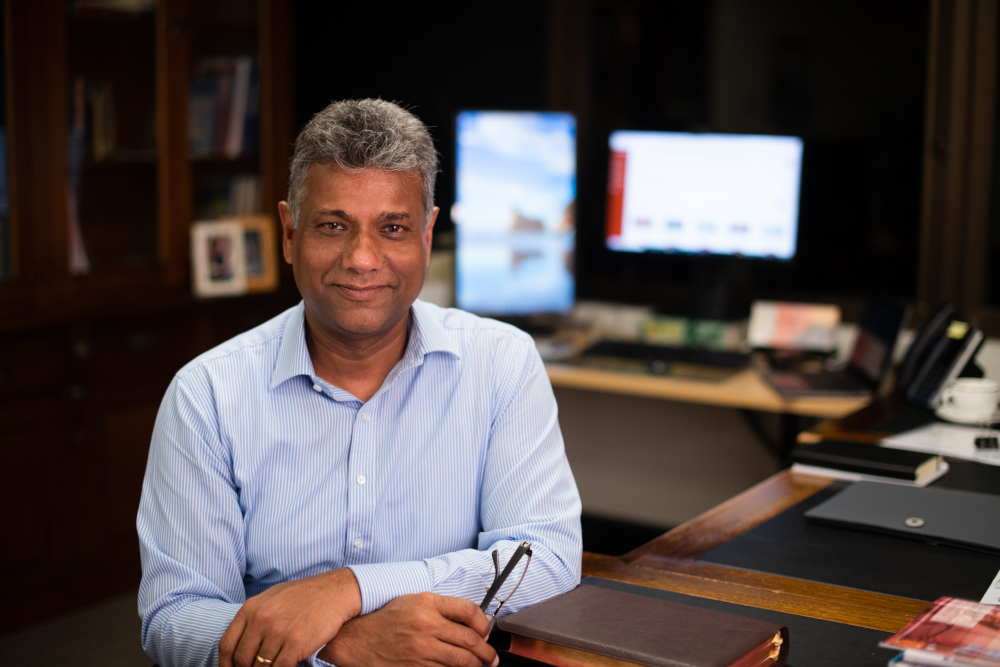
Sydney Anglican Archbishop Kaniska Raffel has issued a strongly worded condemation of Pauline Hanson. Tasmanian Presbyterian Minister Mark Powell did not like it and explained why in a piece in Quadrant magazine. “Significantly, the title of the Archbishop’s statement was, ‘We must reject hateful words and threats of violence,’ Powell wrote.
Which gives The Other Cheek occasion to quote the Quadrant headline “You Expect Better of a Bishop,” which has the unfortunate effect of framing Powell’s piece as an allegation about a person as well as an idea. Powell likely did not write the headline. And on social media, Powell expresses regret at publicaly critical of Raffel.
Yet Powell writes of the Archbishop’s statement: “It seems this is a classic case of leaning to the left while punching at the right.”
The headline of the Raffel piece is used by Powell to frame his discussion. But “hateful words” is morphed into the politically heated phrase of “hate speech” as Powell develops his thesis. Powell takes the restrained words of Raffel and stretches them.
Powell writes: Note how the statement opens by declaring that Senator Hanson’s remarks were “foolish and dangerously divisive” and then immediately links it to “threats of violence against the Lakemba mosque”. What’s more, nothing in the public statement seeks to qualify the connection to Senator Hanson’s comments but instead implies that her motivation was one of hate with the subsequent incitation to violence.”
Raffel certainly begins with saying, “Recent remarks by Senator Pauline Hanson that there are ‘no good Muslims’ are foolish and dangerously divisive. They have been roundly and rightly rejected by leaders across the political spectrum.” But the reference to the threats against the Lakemba Mosque is not “linked” to Hanson in the sense that Senator Hanson is accused of inciting or furthering them.
Raffel simply uses the threats to the Lakemba mosque to indicate this is no time for divisive commentary. “Moreover, threats of violence against the Lakemba mosque are grotesque and must be rejected by all Australians of good will.”
Moreover is an adverb that means “as a further matter; besides” in other words it is not used to link two events, occurances, or ideas, certainly not to suggest a causation.
For Powell, Raffel calling out Hansen’s words is somehow dangerous. “In light of the recent hate speech laws passed by the federal parliament though, these are incredibly serious accusations to make against a federal Senator and her supporters. What’s more, they also demonstrate how these laws might can be weaponised to impact freedom of speech.”
Note again that Raffel did not accuse Senator Hansen of inciting violence. Avoiding the term “hate speech” which is rapidly gaining a legal meaning, Archbishop Raffel simply is against hateful words
For example, Raffel wrote “Christians, Muslims and Jews disagree about the nature of God, the person of Jesus and the way of salvation. We disagree about things that we think of as being of first importance.
“But Christians will reject hateful words about entire communities of Australians on the basis of their religion or culture.”
Making such a strong statement as Raffel did is surely using his right to free speech, and using free speech is one of the best ways to defend free speech, and the same can be said of Powell’s writing, too. Maintaining robust discussion is one of the best ways of promoting free speech, along with the gentleness and respect 1 Peter 3:15 calls us to.
So what did Pauline Hanson say?
Archbishop Raffel is not only leaning left but is a sloppy reader according to Powell. “Unfortunately, many in the media—including Archbishop Raffel—have taken Senator Hanson’s words out of context by stating that she said there were “no good Muslims”, full stop.”
Powell lectures Raffel, “Christian leaders in particular should seek to always speak the truth.”
Powell helpfully gives the transcript from the Hanson interview, including Sharri Markson’s intervention to allow Hanson to walk her comments back.
Senator Hanson: Shari, we’re in a situation where you can either go down one path and we will reap the rewards of our tough stance against Islam and the radicalisation that we will be facing.
Or if we open up the borders and allow more into this country, we’re going to suffer. Future generations will, as other countries have, like France and Denmark and England…and Canada. All these ones who thought, ‘O well, we’ll welcome them.’
I’ll tell you what: I’ve got no time for the radical Islam, their religion concerns me because of what it says in the Koran. They hate Westerners, and that’s what it’s all about.
You know, you say, ‘O there’s good Muslims out there.’ Well, I’m sorry, how can you tell me there are good Muslims? if jihad is ever called, and people must understand this. Go and research, go and understand about this.
The ones who will suffer, as those Jews did on [Bondi Beach]…when they were murdered and slaughtered. And that’s what we’ve got to realise could happen.
Shari Markson: Pauline, there are a lot of moderate Muslims in Australia who are as you put it ‘good Muslims’, but I think we agree that radical, extremist Islam that doesn’t support Australian values has no place here.
Pauline Hanson: Correct, I did mean that.
But here is a better reference.
The key passage occurs from 2:12 on.
Listening to the interaction helps with the tone of Hanson’s words about “no good Muslims” To this listener – and likely the Archbishop – Hanson asks a question “Well, I’m sorry, how can you tell me there are good Muslims?” in a manner and tone that implies the answer that there are no good Muslims.
(There is one difference between the transcript Powell provides and the one above – a question mark after Hanson’s question, which is delineated by a rising inflection.)
There’s a theological point to make about “good with Jesus’ observation in Mark 10:18 “Why do you call me good? No one is good—except God alone,” but the “good muslim” phrase here is about good citizens of Australia.
Powell has a different view “Rather, being a good Muslim means seeking the full implementation of Sharia law upon the rest of society.” but in writing Hanson was ” referencing the cultural implications of fundamentalist Islam” he raises the fair complicated question of what sort of Muslims live in Australia.
Not all are fundamentalists.
Visiting the Lakemba Mosque on an open day, this writer had a discussion with a woman wearing Niqab: A veil that covers the face, leaving only the eyes visible. She was a convert, had persuaded her husband to move to Saudi Arabia for ten years but had returned because “Australia was a better place to live.” That day i learned a little more about the complexity of australian muslim life.
Question: How frequently do the moderate, “good Muslims” come out publicly to condemn acts of violence and terrorism committed by their extremist co-religionists? If silence implies consent, maybe Hanson’s unqualified comment contains some truth?