
Charles Brammall

With regard to another Alexander, above is the “Alexamenos Graffito” (Italian: “graffito blasfemo”– lit. blasphemous graffiti). It is a piece of Roman graffiti scratched into the wall of a house near the Palatine Hill.
It is often said to be the earliest depiction of Jesus, and has been estimated to have been made around 200 AD.
It seems to show a young man worshipping a crucified, donkey-headed figure. Donkeys are literature and legend’s quintessential fools (think Nick Bottom in “A Midsummer Night’s Dream”).
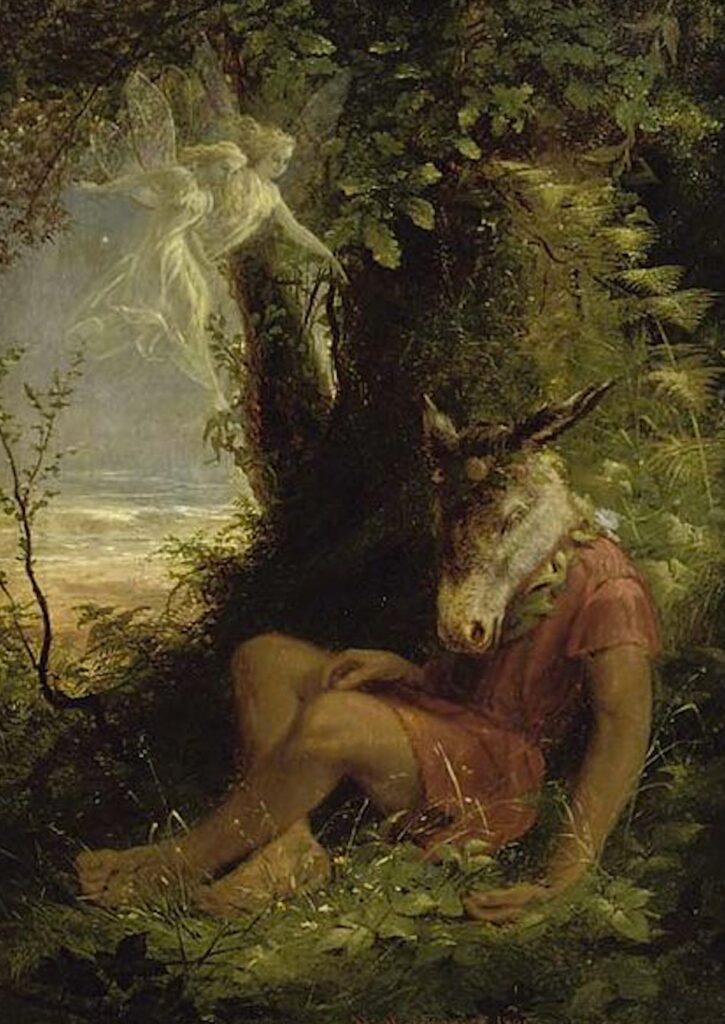
[Bottom Asleep, 1891, by Hubert von Herkomer]
(The worst thing my lovely Dad ever said to me- I never heard him swear- was “You’re an ass of a boy Charles”.)
This Latin speaker’s botched Koine (C1) Greek “tag” translates approximately to “Alex Menos worships [his] god”. It was apparently meant to mock a Christian called Alex Menos, worshipping Jesus- both he and the subject of his worship depicted as foolish asses.
Its tenor is the opposite of another piece of graffiti, this time Counter-Reformational. I was shown it on a door at the entrance to the Great Hall at Christ Church College, Oxford (Hogwarts Dining Hall in the “Harry Potter” films).
Hammered in nails in the wood are the words “no peel”

It is from 1829, and was protesting the British PM Sir Robert Peel’s sudden support for Catholic Emancipation.
. . . .
Alexander the Great was no graffiti artist, but his life (and especially legacy) sketched seminal and lasting changes into the ancient (and modern) worlds. They reach into the present.
“He conquered the world before his thirtieth birthday— but couldn’t conquer himself.”
This historical paraphrase (not a direct, attributable quote) summarises the sentiment found in texts like Plutarch’s Lives.
Therein, Caesar, at 33, famously wept when reading about Alexander. He was lamenting that he had “achieved no brilliant success” compared to Alexander, who had already conquered the world. The former wasn’t SAD about the latter, but about his own life, which he felt was unremarkable at the same age.
It captures the irony that the man who conquered so much of the known world was, in a way, a slave of his own insatiable ambition and the “need to conquer more”.(Reddit). This line echoes down the centuries to this day.
Alexander didn’t merely redraw maps; he rewired the world’s imagination, and without knowing it, laid the groundwork for the Gospel itself. And new research sharpens this in unexpected ways.
The more I read about this Greek, the more I sense God weaving redemption (through Alexander’s ambition and pride) into providence— for me included.
Alexander’s Unintended Herald- The 1st Great Commission
(Mat 8:18-20):
Cambridge historian David Litwa calls Alexander “the great unifier of the ancient mind”. His armies didn’t just conquer territories; they exported language, story, and curiosity. Within a decade, almost the entire known world spoke Koine Greek– the tongue that would later cradle the NT.
Before Jesus arrived, God was already building the communication lines through a pagan general. I feel humbled by that. If divine purpose can inhabit a campaign of heathen conquest, then maybe God can also infiltrate, even utilise, my own mixed motives.
The Empire’s Neural Network- Alexandria:
Litwa observes that in Alexandria, “ideas could finally travel as easily as soldiers.” The libraries, ports, and marketplaces formed a network of restless minds all asking the same questions: “Who am I? What is truth? What holds everything together?”
It’s no coincidence that John’s Gospel begins, “In the beginning was the WORD”. Alexander’s world had already been primed for the vocabulary of incarnation.
So, what is my “Koine Greek”-The language through which my family and friends might still hear grace?
It is not Greek, obviously (I did poorly in it at Bible college). Maybe it’s things like honesty, especially about my sins, foibles, and peccadilloes.
Integrity, trustworthiness, and loving truth-telling. Being willing to be with people for long periods, even in silence. Being considerate, telling the truth, and being loyal. Humility, self-deprecation, and storytelling?
It seems to me those things are my generation’s Lingua Franca. Her mother tongue. That’s what “my people” seem to understand and relate to when their eyes light up and they feel understood and seem to “get” it.
The God Who Descended, the King Who Reached Up-
The recent research of Christian Thrue Djurslev, Assoc. Professor of Classical Philology in the School of Culture & Society at Aarhus University, Denmark, is incisive. It shows that early Christians didn’t erase Alexander. They reinterpreted him and saw in him a cautionary reflection: the man who reached upward to be divine, contrasted with the God who stooped downward to be human.
Alexander grasped, Christ gave:
“Jesus,… who exist(ed) in the form of God, did not consider equality with God as something to be exploited (grasped). Instead, he… took on the likeness of humanity. And when he had come as a man, he humbled himself … For this reason God highly exalted him,… so that at the name of Jesus every knee will bow- in heaven and on earth, and under the earth— and every tongue will confess that Jesus Christ is Lord” (Phil 2:6-11).
This mirror reflects me, too. At times, I have been tempted to have the same impulse— empire dressed as ministry. Tempted to rename my self-promotion vision and my ambition calling. Yet the only Bible passage I’m aware of that urges believers to be ambitious for something is 1 Thess 4:10-12:
“… we encourage you, brothers and sisters,… to seek to lead a quiet life, to mind your own business, and to work with your own hands,… so that you may behave properly in the presence of outsiders and not be dependent on anyone.”
Our ambition? Seeking to live quietly, not gossip, and work with my own hands, so I’m not beholden to anyone. (Also, so that my hands will be occupied and therefore not steal?)
Ultimately, why are these the things I should be ambitious for?
So that I’ll behave appropriately when I’m with unbelievers, and not be a drain on anyone, that is, for the sake of their salvation, because my life is adorning the Gospel, not dragging it through the mud.
Alexander’s ambitions certainly weren’t those of 1 Thess 4. They were to grasp at being God. But Jesus’ kingdom still asks me to trade spectacle for surrender.
Alexander’s Shadow: Greatness Outrunning Grace.
Professor Andrew T. Fear teaches Classics at Manchester and Keele Universities. His academic publications cover the provinces of the Western Roman Empire. Fear notes that Christian writer Orosius used Alexander as a living parable of futility: an empire brilliant, ruthless, but short-lived. It “troubled the divine story,” Orosius wrote, because though glittering, it was fragile and could not endure.
Alexander at God’s Gates: Power Meets Purity
Josephus tells us that Alexander once visited Jerusalem and recognised the high priest from a dream. Legend perhaps— but even legends betray longing. Humanity wants power to kneel before purity.
And somehow, in Christ, it finally does. If God could turn Alexander’s empire into a runway for the Gospel,
He can repurpose my own scattered ambitions, too.
Macedon the Polyglot: Translating Glory into Grace
Litwa writes, “Theology was born in translation.” Early Christians in Alexandria didn’t hide from culture; they entered it— translating philosophy into faith, and faith into language the world could bear.
My “city” is a new Alexandria: noisy, diverse, opinionated, over-connected. And if I’m serious about following Jesus, I can become multilingual in love- fluent not in Koine, but in grace.
The Tomb and the Carpenter: Alexander’s Empire Unravels.
Alexander’s glory lasted barely a generation. His generals tore the empire apart, and his tomb is still lost. But the carpenter who conquered nothing has outlived every conqueror.
That means I can now rethink. Maybe greatness isn’t what God blesses. Maybe the real revolution is quiet faithfulness. But I keep wanting to do something for God. Not even something spectacular necessarily. Just SOMEthing. I get frustrated if, at the end of a day, I’ve done nothing to advance His kingdom, no relational Word ministry.
But, (and but is the wrong word), I can pray, only through Jesus’ death. I don’t have to think “Oh well, I may not have done any people ministry today, but at LEAST I can pray. But praying IS Word ministry. Taking my requests to God is never “well, at least”. It is never a last resort. It is the MOST powerful thing I can do for His kingdom.
Not because of the power of PRAYER, but because of the power of the One to WHOM I pray.
And praying is not the only Word ministry I can DO if I’m unable to do any other. Perhaps God wants me to be someone changed by Him.
Macedonian Blueprints: Scaffolding for Another Kingdom
All this research reveals a divine plot twist: God writes not around empires, but through them. Alexander built the roads, the language, and the curiosity that would later serve the Gospel.
In the NT, God reveals Himself in a language that the pagan Alexander brought to Palestine. And it wasn’t a contingency plan, Prov 21:1-
“A king’s heart is like channelled water in the Lord’s hand: He directs it wherever he chooses.”
And maybe my own flaws and detours are similar scaffolding to what Alexander built for the Gospel- temporary structures, for eternal things.
So in Christ, I can stop trying to be great. And start trying to be faithful. Greatness collapses. But faithfulness endures.
The Great and the Crucified.
If Alexander lived now, he’d be an influencer. He would have followers, sponsors, and a brand called something like Conquer. And some tiny part of me, sometimes, maybe, would be tempted to subscribe.
But the kingdom I’m called to follow wins by losing, rules by serving, and conquers by forgiving. Thank God! A kingdom definitely not of this world.
So if I want to live “anti-Alexander”.
I can obey instead of craving applause. I have the privilege of listening instead of broadcasting. And of disappearing so that Christ can be seen more, as John the Baptiser said in Jn 3:29-30:
“He who has the bride is the groom. But the groom’s friend, who stands by and listens for him, rejoices greatly at the groom’s voice. So this joy of mine is complete. He must increase, but I must decrease.”
So thanks be to God, grace still writes through my imperfection, just as it once wrote through a man
who thought he was writing his own glory. In fact, it doesn’t just write THROUGH my imperfection, it writes BECAUSE of my imperfection, 2 Cor 12:9-10:
“God said to me (Paul) ‘My grace is sufficient for you, for My power is made perfect in weakness.’ Therefore, I will boast all the more gladly about my weaknesses, so that Christ’s power may rest on me. That is why, for Christ’s sake, I delight in weaknesses, in insults, in hardships, in persecutions, in difficulties…”
Because in the end, history never belongs to the conquerors. It belongs to the Crucified.
From Babylon’s Ruins.
They say Alexander wept because there were no more worlds to conquer. I weep because I still keep trying to build one. Some nights I can almost hear his ghost – not the marble general of statues,
but the exhausted boy-king of Babylon, lying feverish and alone among his trophies.
He whispers, “I built everything except peace.” And I realise, I’ve done the same in miniature. Every time I’m tempted to reach for recognition, I raise another small Tower of Babel to myself. Another gold statue, a Hanging Garden, a golden bull, to myself. Every time I crave applause (and I do, often), I conscript my gifts into my own campaign.
But Christ’s map is drawn upside down. The last are first. The meek inherit. The cross sits where the throne should be. In fact, the cross IS the throne. And that changes everything.
Will I accept that decision of my Father’s, like Mary did in Lk 1:38? “‘I am the Lord’s servant,’ said Mary. ‘May it happen to me as you have said.’ Then the angel left her.”
Because when I finally stop trying to conquer, I can start belonging to a billion-strong, eternal, international adopted family. When I stop trying to prove, I can start becoming the likeness of Christ. And when I lay down my little empire, I discover that the King who never raised a sword has already conquered my heart.
So from the ruins of my Babylon, I pray: Let my greatness die young, that grace might grow old in me.
Let my ambitions fall, that Your kingdom might stand. Let me trade my empire for Your embrace.
And if one day, someone writes of me— not “he conquered,” but “he was changed” it will be enough.
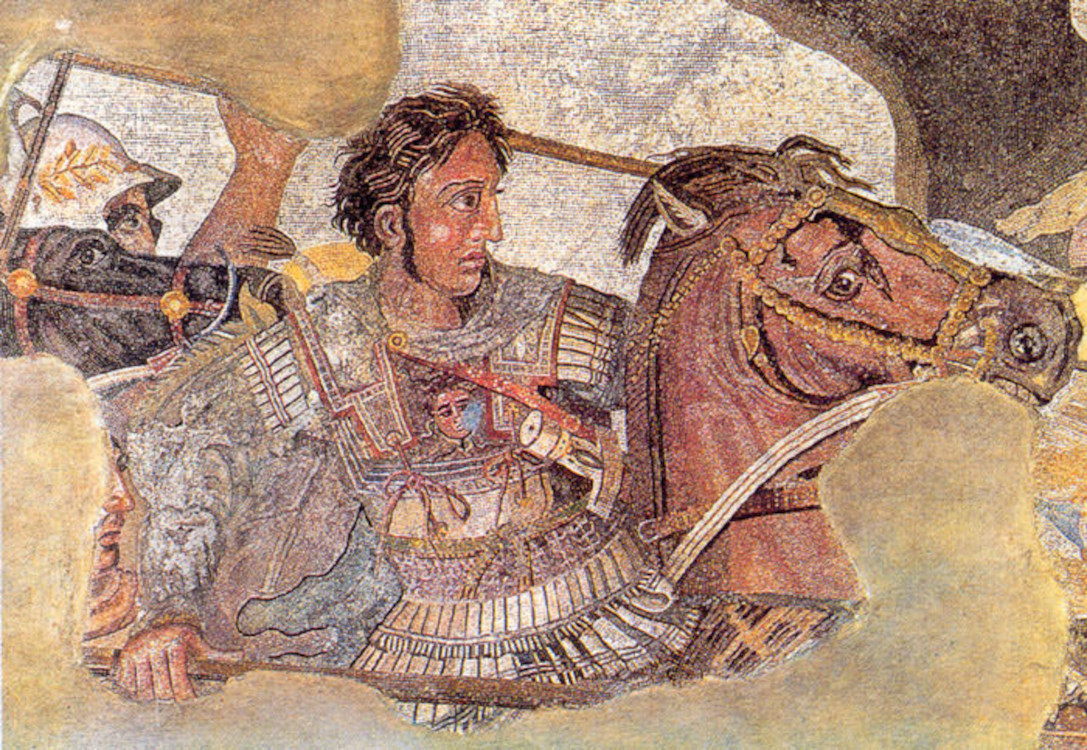
Manin Image: Alexander, depicted with his horse Bucephalus, House of the Faun, Pompeii. Image Credit: Ruthven.