
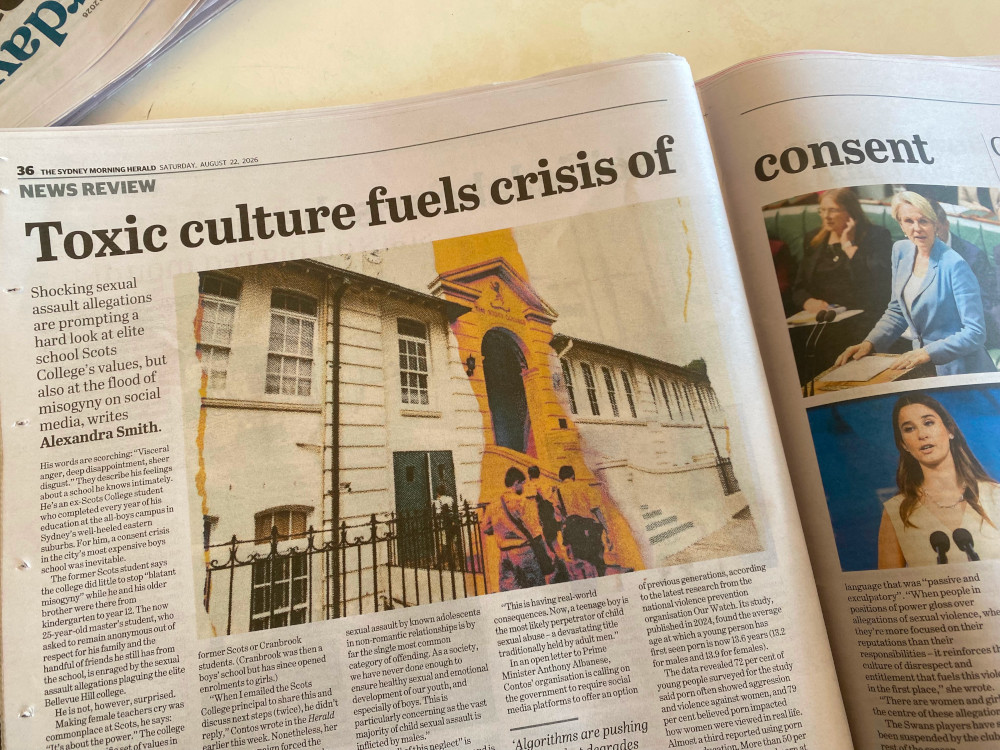
At the end of a very bad week of alleged sexual asaults by school students and Swans players there’s been some insightful commentary from Christian ministers. Here’s three, a Baptist, a Uniting and an Anglican with good points to make.
Let’s start with the sobering prespective in a comment by Baptist Minister and podcaster Megan Powell du Toit who calls for Christians to confront uncomfortable reality.:
“This week we have had three accounts in Sydney of alleged group sexual assaults. Two have been by teen boys who attend a private boys school with each other. The other by members of a sports team.
“We need to have the guts to admit that this kind of crime is not about aberrant individuals. It speaks to the culture present in some all male groups and institutions. And given the two schools are church founded (one Presbyterian, one Marist), we Christians need to confront the reality that this type of culture can be present in our institutions.”
But a different take comes from Jon Humphries, Minister of the Word at St Matthews Uniting Church Baulkham Hills who points at consumerism and porn, and urges us not to blame the schools.
…. “We seem to thrive in a culture of sensational disrespect. We love to watch and be incensed at news stories being incensed at the behaviour and attitudes of others, all the while not comprehending how that is insidiously feeds in us the root disrespect and lack of compassion which in the worst way becomes manifest in abhorrent behaviour. This then combines with self-centred consumerism to become the awful attitude which leads to abusive behaviour.
“The schools aren’t to blame for the actions of the boys. The parents aren’t to blame. Don’t get me wrong, there is likely more both school and family can be doing to better shape our attitudes and behaviour of young people. However, the reality is that most schools are working hard to cultivate attitudes of respect, compassion and responsible behaviour which results in our young people becoming socially responsible citizens. Christian/Church schools particularly seek to shape this through witnessing to the Christian faith and the way God in Christ calls us to live.
“We are failing though. We need to look at the system. Our consumer society works to create an inherent consumption of everything. We not only consume goods and services, but also media and content. We even consume people. The entitlement that people believe is their due and the disrespect inherent in a total consumer mindset is such that we see it literally raging in all areas of society. We have rage in our service spaces so that shops, hospitals, schools and most public spaces where people are served by other people have to have signs put up reminding people to be respectful and that aggression will not be tolerated. I even heard a constant message to remind meand others to be considerate on the Metro. Self-entitlement fuels impatience and impatience fuels aggression and all of this is a failure of respect and decency in mutual humankindness.”
“I believe porn and its consumer message that sex is a consumer act, and others are there to provide is what we want and believe ourselves deserving of is no doubt a factor in the abusive behaviour of the boys and men. Sex has become a victim to this consumer attitude. It has become less about mutual expression of love, affection and intimate connection in human relationship and more about personal gratification.”
Michael Jensen, Anglican Rector of St Mark’s Darling Point and podcaster with Powell du Toit, has a piece “The Limits of Moral Education” on his Lost Arts substack, which suggests both schools and their critics may be off target.
“The first thing to say in response is that young people are not exclusively – or even primarily – morally formed by schools. Children are, for good or ill, the children of the parents. From birth, they are shaped by their parents’ prejudices and anxieties. Teenagers of course will deny that it is the case; and parents will wonder what influence they have. But it is observably true in my experience as a former schoolteacher, that kids come to school already shaped in a moral direction. They are not simply lumps of clay to moulded….
“Schools do profoundly influence children. I wholeheartedly believe that, or I wouldn’t have committed so much of my life to teaching, supporting, governing, and being an active parent at schools. Institutional cultures matter a great deal. Bad behaviour and entitlement can be normalised within schools. And the opposite is true: good behaviour can cultivate excellent habits.
“But the causal story is far more complex than ‘bad boy = bad school’, or ‘good boy = good school’.
“So what should or could schools claim instead? I would certainly not have schools give up on seeking to do what they can to cultivate human beings of good character. But I would especially urge Christian schools to beware of an overly optimistic anthropology. Contemporary education, as I’ve said, tends to believe that, given the right inputs, the right role models, and enough formation, you can produce a good person. Our private schools and their critics believe the same thing: that if students are misbehaving, they mustn’t be receiving the right teaching.
“What has happened here is that we’ve secularised the Christian doctrine of sanctification while removing the Christian doctrine of sin. We’ve retained the fine ideals of virtue, discipline, service, integrity, and respect. What school wouldn’t want to teach those? But we’ve lost the fundamental but awkward Christian insight that the human heart is itself disordered.”
“What has happened here is that we’ve secularised the Christian doctrine of sanctification while removing the Christian doctrine of sin. We’ve retained the fine ideals of virtue, discipline, service, integrity, and respect. What school wouldn’t want to teach those? But we’ve lost the fundamental but awkward Christian insight that the human heart is itself disordered.”
This is also the problem with Liberal Christianity: it affirms the goodness of creation while overlooking the fact of sin, original sin even. Then when things go wrong, it blames poor organisation of society instead of individual selfishness and self-seeking as lying at the core of the problem.