
Charles Brammall
In 1994, in a small Rwandan town, a lady called Immaculée Ilibagiza hid in a 3 x 4 foot bathroom in a pastor’s house with seven other women, for 91 days, during the Genocide. Outside, neighbours, and people she had grown up with were hunting her and her family to maim and kill them, including with machetes.
Inside she prayed, not with calm, Christlike grace and trust, but with a fractured soul barely able to form words, unable at first to pray “forgive us as we forgive,” because forgiveness felt like a contradiction of justice itself.
And yet something shifted in that hidden place. Not the danger outside, but the world within her heart and spirit. Slowly, painfully, she began to pray for those who would kill her. A long time later, she would meet one of those men face-to-face and tell him she forgave him.
At this point, I am tempted to be troubled because this moment unsettles me and disrupts my instinct for ethical simplicity. It threatens to force me to confront a deeper biblical truth: Justice/judgment and mercy are not rival forces, but mysteriously interwoven in the hands of God.
Where justice is never absent, and mercy is never shallow, nor expunged or redacted by justice. Mercy is God’s natural work, justice His “alien” work: “God will rise up… in wrath… to do his UNEXPECTED work… his UNFAMILIAR task.”
Yet justice is never ABSENT from God’s work, Isaiah 26:9 – “When your judgments are in the land, the inhabitants of the world will learn righteousness.” and Psalm 36:6- “Your judgments are like the deepest sea.” We are not dealing with surface ethics, but with oceanic, Mariana Trench-like depths that require reverence rather than haste, and humility rather than certainty.
Judgment #1: The Garden
Judgment #1 is not thunder and lightning, but a gentle question in a beautiful garden in Gen 3:9- “Where are you?”- not born of ignorance, but of exposure. And a loving longing to reunite, to relate. God is drawing out what humanity has BECOME, not merely what we have DONE. The hiding is already the judgment, revealed inwardly.
Judgment unfolds as consequence rather than arbitrary punishment, 3:17- “The ground is cursed because of you… You will eat from it by means of painful labour.” The world itself becomes resistant, as though creation now echoes the rupture of relationship….
Reference the 70s Aussie TV ad for Sunsilk Shampoo. A lady is washing her hair in a beautiful lake, and when she finishes, she steps out, drawing the lake around her like a towel, and bringing, dragging, pulling it with her. When we declared autonomy over God in the garden, we drew the whole of creation with us, corrupting it at the same time, Romans 8:19-22:
“Creation eagerly waits… for God’s sons to be revealed. For the creation was subjected to futility—not willingly, but because of him who subjected it—in the hope that the creation itself will also be set free from the bondage to decay into the glorious freedom of God’s children… The whole creation has been groaning together with labor pains until now.”
Yet even here, judgment is already braided with mercy, Gen 3:21- “The Lord God made clothing… and he clothed them.” Shame is covered before exile fully lands, which means judgment is never allowed to be the final garment placed on humanity.
And even deeper, hope is embedded in judgment itself: “He will strike your head,” Genesis 3:15. The serpent is judged, but not without the promise of its eventual defeat. The ripple effects begin immediately: “They became more corrupt in all their actions.” Zephaniah 3:7. Sin is not static; it spreads, mutates, and intensifies across time, culture, and generations, like a moral gravity bending everything toward fragmentation.
Judgment #2: Jesus’ Death and Resurrection
Judgment #2 stands at the centre of all history, where Jesus Messiah becomes the focal point of divine justice and mercy, not as an observer of judgment but as its bearer, Is 53:6 – “The Lord has punished him for the iniquity of us all.”…
And 2 Corinthians 5:21 – “He made the one who did not know sin to be sin for us.” Matthew 26:32 (ref. Zechariah 13:17), “Strike the shepherd and the sheep of the flock will be scattered.” Here is the theological shock: judgment does not disappear; it is absorbed. It does not evaporate; it is exhausted in Christ.
This is why forgiveness in the Christian story is not moral optimism, but theological realism. It is not ignoring sin, but confronting it at its deepest cost.
Echoes of this are visible in the radical forgiveness of the Amish community in Nickel Mines, Penn., USA, after the Oct 6 2006, West Nickel Mines School shooting. Gunman Charles Roberts IV took hostages and shot ten girls (aged 6–13), killing six, before taking his own life at the school. It is the deadliest shooting in Penn. history. The Amish community’s astonishing forgiveness and willingness to reconcile widely shocked the national media.
Our brothers’ and sisters’ response was not the denial of evil, but a refusal to let evil have the final word, just like their Heavenly Father, Micah 7:18, “He delights in faithful love.” The same is true of the forgiveness of young Christian couple Danny and Leila Abdullah, who lost three of their children aged 14, 12 and 8, and their niece, 12, when a drunk and drugged driver hit them on an Oatlands, NW Sydney, footpath on their way to buy ice creams.
The couple became known for publicly forgiving the driver. They expressed deep grief, but chose to forgive, choosing a path of reliance on Jesus and “freedom” over bitterness. They subsequently established the “i4give Foundation” to commemorate their children and promote forgiveness.
The instances of believers preferring mercy over justice (like God does) are manifold. In Feb 2015, 32 Coptic God-fearers were kidnapped and beheaded in Libya by ISIS militants. Despite the brutality of the act, the families of the victims and the broader Coptic community responded with inexplicable forgiveness.
A video before the executions showed the men refusing to renounce their faith and calling out to Jesus (“Ya Rabbi Yassou” – My Lord Jesus) during their final moments. The wives and families of the martyrs said they did not hate the perpetrators, but instead prayed that God would soften their hearts, forgive them, and lead them to the “right path”. They acknowledged their deep pain but spoke of the victims having been placed in a “good place they couldn’t have dreamed of.”
Mercy triumphing over justice. Just like at the cross. God’s character, His personality, Him at His core. His inner being, His essence, His very kernel. His heart. And ours too. Because after all, it goes with being a Jesus follower. As night follows day. S/he who has been forgiven much, will forgive much…
The Lord has had mercy on ME – which does the miracle of freeing me up to forgive my enemies, and those who persecute me. And praying for them- the best for them. And EVEN to forgive my sisters and brothers in God’s family!
That is, mercy is not reluctant in God; it is His joy, the thing that gets Him out of bed in the morning, and lights His fire. His happy place, the thing that floats His boat. As far as He is concerned, for Him, showing mercy is the good life.
Judgment #3: The Mysterious Consequences of Sin
Judgment #3 is the most unsettling because it is indirect, layered, and often invisible in its logic. It is the judgment of consequence, where moral actions echo far beyond their origin point, Galatians 6:7- “Whatever a person sows he will also reap.” Hosea 8:7, “They sow the wind and reap the whirlwind.” Exodus 20:5, “… Bringing the consequences… to the third and fourth generations.”
Sin behaves like a force that reshapes environments, not merely events. It enters families, reshapes emotional patterns, distorts trust, and fractures societies in ways no single act fully contains. Yet Scripture resists simplistic interpretation: “The person who sins is the one who will die.” Exodus 18:20. And about the man born blind in John 9:3 – “It was not that this man sinned.” That is to say, there is judgment in the world, but not every suffering is a direct moral verdict of God’s on a particular person for a specific sin.
Even within the life of the church: “This is why many are sick… and many have fallen asleep.” 1 Corinthians 11:30. Because even here, Scripture restrains human speculation. We are never given permission to map every tragedy onto a specific sin. I can NEVER say “Person X is suffering in this way because God is punishing them for sin Y they committed”, without Him INTERPRETING their suffering for us, as in 1 Cor 11.
Forgiveness, however, does not erase consequence. Because, although “As far as the east is from the west, He has removed our transgressions.” Psalm 103:12), yet David still lives through the aftermath of his sin in 2 Samuel 12:13–14: “David said… ‘I have sinned against the Lord.’ Then Nathan replied ‘And the Lord has taken away your sin; you will not die. However, because you treated he Lord with such contempt in this matter, the son born to you will die.” Thus forgiveness is real, but consequences remain historically embedded and continue for the rest of his life.
This might be true for me, and you, too. We have been well and truly forgiven and shown mercy, and embraced into the Father’s bosom. I am rescued, a citizen of heaven, can’t lose my salvation, and eternally safe… but the consequences of a past sin, or even foolishness, may affect me (not eternally) for the rest of my life. I overeat and under-exercise, so I develop Diabetes.
I drink too much, so become an alcoholic. I smoke, so I get lung cancer and die prematurely, selfishly leaving my family, wife husbandless and children fatherless. I am promiscuous, so I contract AIDS, or have a child as a single parent. I take drugs, so I get Hep B or C. I steal, so I spend time in prison and am restricted from certain jobs for the rest of my life.
The story of Chuck Colson (“Nixon’s handyman”) in Watergate is revealing. After his involvement in the scandalous crime, he experienced profound conversion and forgiveness. Because of this, he chose not to plead innocent, and therefore still lived with the enduring consequences of incarceration and public memory of him as anathema, a pariah. Grace redefined him, but did not rewrite history. (Ironically, and miraculously, my neighbour and “second dad” was saved through Colson’s prison ministry!)
Judgment #4: The Final Judgment
Judgment #4 is the horizon of all things, where everything hidden is brought into the light of God: “The dead were judged according to their works.”, Rev 20:12. “Everyone will have to give account on the day of judgment for every careless WORD (even- ed.) they have spoken”, Matthew 12:36.
Jude 1:14-15: “Look! The Lord comes with tens of thousands of his holy ones to execute judgment on all, and to convict all the ungodly, concerning all the ungodly acts they jave done in ungodly ways, and concerning all the harsh things ungodly sinners have said against Him.” Nothing is omitted, nothing forgotten, nothing misremembered.
And yet for those in Christ, something must be said with clarity that does not flatten mystery: there is NO final judgement for condemnation regarding salvation, because Christ has already borne that judgement in full: “There is now no condemnation for those in Christ Jesus.”…
Romans 8:1: “He himself bore our sins in his body on the tree”. 1 Peter 2:24- “Who is the one who condemns? Christ Jesus is the one who died”, Romans 8:34. The decisive judgement has already fallen on Christ, which means the final judgement for believers is not about determining destiny, but revealing what grace has already accomplished.
1 Corinthians 3:12–15 is essential here: “If anyone builds on the foundation with gold, silver, costly stones, wood, hay, or straw, each one’s work will become obvious, for the day will disclose it because it will be revealed by fire; the fire will test the quality of each one’s work. If anyone’s work that he has built survives, he will receive a reward. But if anyone’s work is burned up, he will experience loss, but he himself will be saved – but only as through fire.”
Every single believer through time and eternity WILL BE SAVED. No doubt about that. This is not a test of salvation, but a revealing of the substance of how we have spent our time in this life. It is not about earning heaven, but about revealing what grace has built.
And here the question becomes deeply personal and strangely beautiful: what can possibly be carried into eternity if nothing earthly survives? (Paul Kelly’s sparkling song “You Can’t Take it With You”). Scripture’s answer is not possessions. But,,, people. Paul says to his Thessalonians sisters and brothers “what is our hope, or joy, or crown of boasting before our Lord Jesus at his coming? Is it not you?” (1 Thess 2:19)
And to the Corinthians, “I became your father in Christ Jesus through the gospel.” (4:15). And the Phil Poppins, “Therefore, my dear brothers and sisters… you are my crown.” (4:1). Paul’s (God’s) vision of eternity is relational. The “crown” he brings is not achievement but redeemed relationships, people formed by grace through his life and ministry.
If nothing impure enters glory, then what remains must be what grace has purified: love expressed in others brought into, or conformed into the likeness of, Christ.
So the only enduring treasure is not status, achievement, or accumulation, but people. Those we have encouraged, discipled, prayed for, pointed to Christ, or quietly strengthened along the way. Those who will be there because grace reached them through us. Just like my second dad, and Chuck Colson.
Conclusion: Why only four?
Why only “Four Judgments of God”? There are many other judgments of God in Scripture that could also be explored: the flood in Genesis 6–9, Babel, the 40 yrs of wilderness wandering in Numbers 14. The exiles of Israel and Judah to Babylon, the destruction of the temple in Matthew 24 and its historical fulfilment in AD 70. The final judgement of Satan in Revelation 20:10…
Each of these is historically grounded, theologically weighty, and spiritually instructive, yet each ultimately participates in the same unified reality already expressed in Judgements 1 to 4. These, I believe, form the most important doctrinal “scaffold” or theological “skeleton” of God’s judgements in His Words…
Upon these, we can construct the building of His justice, and put meat on the bones of His judgment. I believe these other alternatives fall within and flow out of the four major judgements. But please feel free to differ! And engage me in the comments. I’m keen to be corrected.
Likewise, I don’t believe the 4 judgments are separate systems, but are variations of one divine logic: sin is real and consequential; judgement is serious and unavoidable – mercy is God’s greatest joy, His hobby horse. Because Messiah bears the decisive judgement, and history moves toward a final unveiling where justice and mercy converge without contradiction or remainder.
And so the whole arc comes into view again, now more slowly, more weightily, more fully. We are not living in randomness. We are not living under indifference.
We are living in a world where judgment has already been carried by Christ, consequence is still unfolding in history, mercy is already active in hidden and visible ways, and the final word belongs not to collapse but to grace that reveals, heals, and restores.
And in the end, we stand not before a cold ledger of moral accounting, but in the place where judgment has been borne, and mercy is alive. Where consequence is real, and grace is already writing the final meaning of everything that has ever been, and everything that will ever be. Amen
With thanks to Rev Simon Manchester for his splendid preaching on this topic.
Prayers
Please give thanks to God with me for His merciful justice and inexplicable mercy:
Lord Jesus
Thank You that You have already borne the judgment I deserved;
Please teach me to live in the freedom of “no condemnation”, and to build a life of gold, not for earning, but out of gratitude.
Amen
Merciful and just Father,
In the tangled consequences of sin I cannot fully understand, please give me humility, compassion, and trust; please keep me from harsh judgments, and make me an instrument of eternal heavenly glorious mercy in the lives of others.
Amen
Precious non-partisan Father,
Please shape my life so that what endures is love for people; let only those I encourage, serve, and point to Christ be my joy and crown in Your presence forever,
Amen
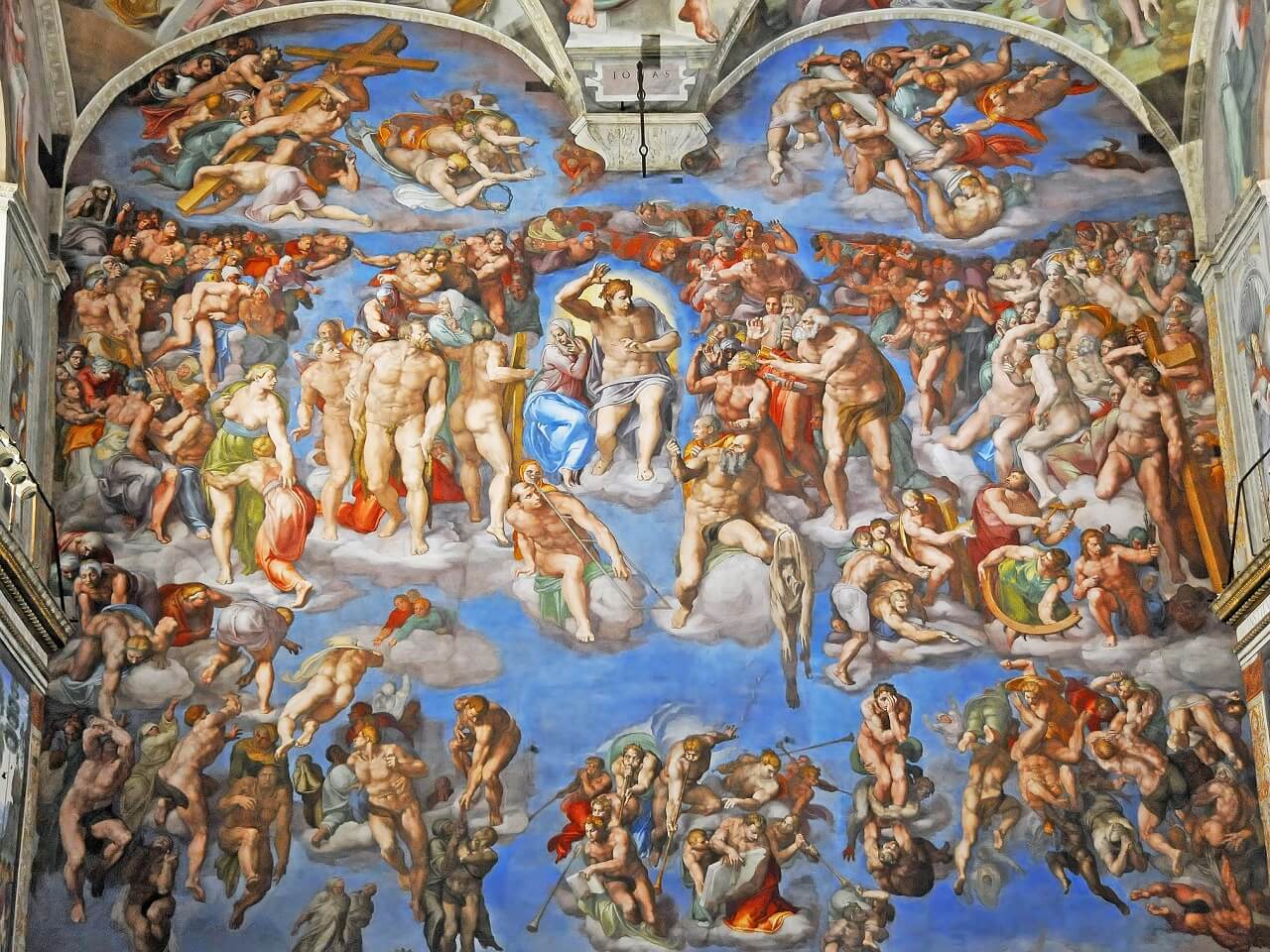
Image, The Last Judgment wall in the Sistine Chapel by Michelangelo. Image Credit: Dennis Jarvis / flickr.com