
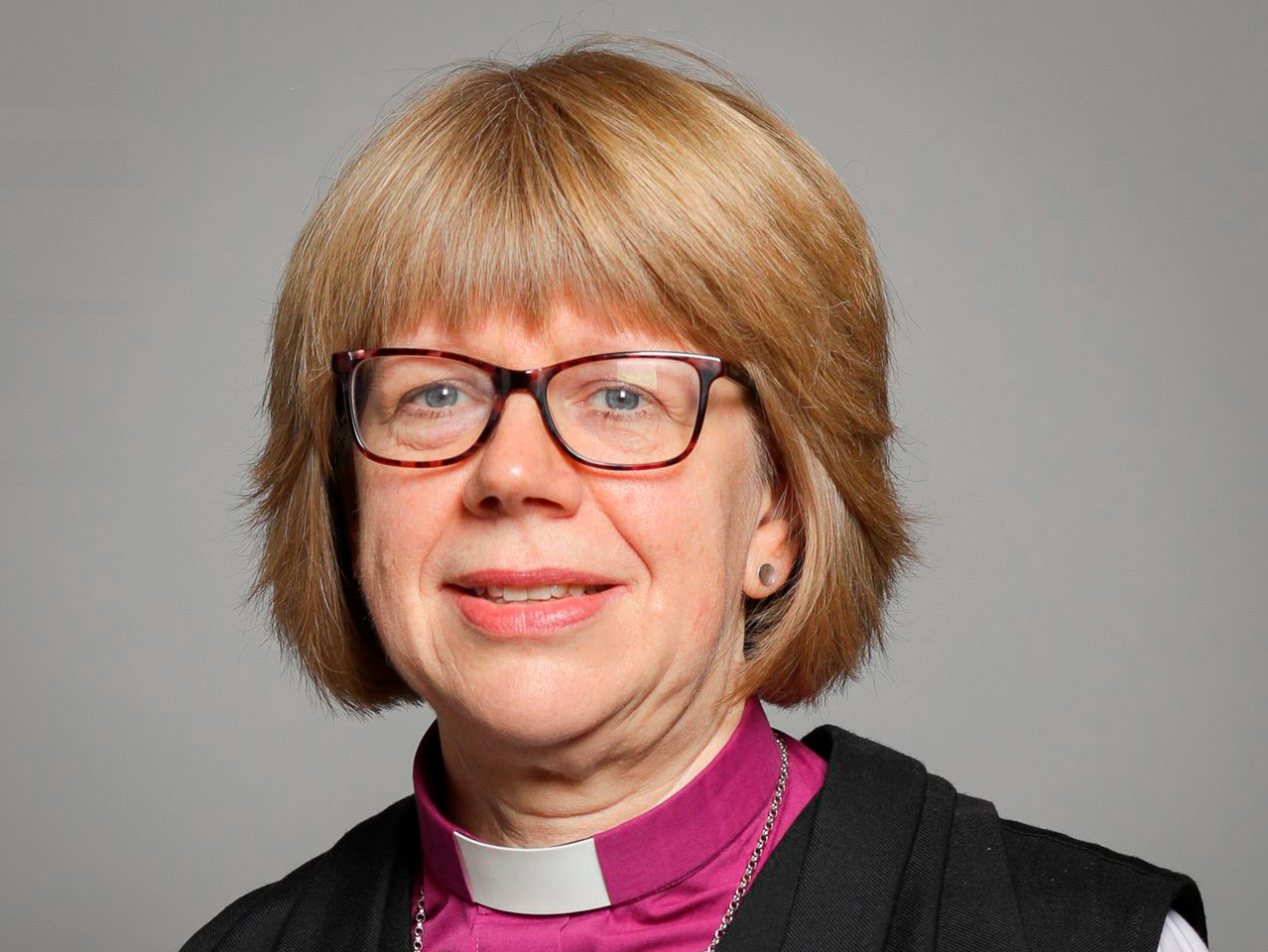
“When we write biography, it is because it says something about today,” compere of ABC Late Night Live, David Marr commented this week. He was not contemplating “Archbishop Sarah Mullally”, the biography produced at lightning speed for her installation, but the book has as much to say about Anglican life as it does about her.
It’s no potboiler. Author Andrew Atherstone, Professor of Modern Anglicanism at Oxford University, is a serious writer and academic who will present this year’s Moore College Annual Lectures.
Sarah Mullally is a more accessible figure for Australians than most of her predecessors. Not Eton and Oxbridge, but her local comprehensive school and a nursing degree from a Polytechnic. Young Sarah Bowser was encouraged to attend St. John’s Woking, one of several large Anglican evangelical churches in the Bible belt around London. “St John’s displayed an energetic Christian confidence and passion for growth,” Atherstone wrote. He quotes the parish mag noting St John’s had “overflowing Sunday schools, a flourishing youth ministry and 40 midweek Bible Study groups…”
“Boswer was raised in a church environment of intense evangelical fervour.” Perhaps readers can recognise similar churches in Australia today.
St John’s was not closed off – from 1976, the church was led by Jimmie Song, the first ethnically Chinese in the Church of England to run a parish. He had experienced the trauma of occupation in Singapore, and was intriguingly converted in Australia. This was an early introduction to Bowser of the issue of ethnic inclusion in the Church of England.
Asked by the Church Times, as a bishop of London, to write to her 14-year-old self, Mullally wrote, “Have confidence in who you are, the skills and gifts that you have and know that your dyslexia will not be what defines you… The decision you are making to follow Jesus will be the best decision you have ever made. Soon, there will be a time when you cannot imagine life without the knowledge of God’s love….”
At the Polytechnic of the South Bank, studying her Nursing BSc, Bowser was Christian Union President in her final year, 1983, and attended an evangelical church, St Stephen’s South Lambeth, in a very different district to prosperous Woking, and a thoroughly multicultural congregation. Here, Bowser met her husband and experienced her call to Anglican Ordination.
The minister, Christopher Guinness, was the nephew of Howard Guinness, a famous evangelist to university students in Australia, and a second cousin to apologist Os Guinness. Atherstone tells a story that indicates that inclusion may have been hard fought in the parish. Guinness decided that the six lay distributors at Holy Communion should be three white and three black. This new policy brought racial prejudice to the surface within the congregation, and some expressed their fears that ‘white people might refuse to receive communion from a black hand.’ Guinness insisted, however, that this public demonstration of equality spoke louder than a thousand sermons on the unity we all have in Christ.’
It might have been the Tuesday club, a children’s outreach program, where Eamonn Mullally connected with Bowser, or perhaps it was their serving together on the Parish Council; they married in 1987. But Mullally stepped back from Parish Council a couple of years later owing to work pressures. She was experiencing a rapid rise through the ranks of nursing, becoming Chief Nursing Officer for England in 1999.
By then, she was in her second year of a part-time ordination course. The ministers at St Stephen’s were complementarian, but they gave her the opportunity to preach.
In time, Mullally became curate of Battersea, moving from a salary of £110,000 to £17,500 (plus accommodation. Later appointed as rector of Sutton, an area with a lot of urban poverty and a church attendance of 240 among 24,000, which was no longer viable, “she proclaimed a practical gospel, made visible through social activism. She asked: ‘Is the kingdom of God about peace, justice and love, about welcoming the stranger, caring for the poor and welcoming the sick – do we know what must be done to bring the Kingdom of God into our community.” She recalled offering food and clothing, finding night shelter places, sleeping bags and shelter in church crypts.
Mullally continued to place social justice front and centre as canon treasurer of Salisbury Cathedral, which is best known perhaps as housing a copy of the Magna Carta. Mullally aimed “to throw off the Cathedral’s image as a pastoral idyll and to build instead a reputation for championing justice and equality.” After all, the Magna Carta was a touchstone for quality.
Mullally was one of the first women to be appointed Bishop in the Church of England, but in Exeter and later London, won the respect of traditionalists, both evangelical and Catholic. As Atherstone tells it, she embraced the “Five guiding principles ” set up to allow for mutual flourishing. While her predecessor in London, Richard Chartres, had appointed only white men to area bishoprics, Mullally appointed two women and “two global-majority-heritage men. Atherstone notes, “The pursuit of racial justice was a natural outworking of Christian inclusion and equality… Beginning with the Christian principle that ‘we are ALL created in God’s image and are equally God’s children,’ Mullally argued that Scripture was a story of increasing inclusion, ‘of the widening of God’s tent.'”
Her focus on equality led Mullally to oppose the 2025 euthanasia bill in the UK parliament, arguing “It would signal that Britain was now ‘a society that believes that some lives are not worth living.'”
However, Mullally was much more guarded in the role of leading the Living in Love and Faith debates, the Church of England’s same sex blessings consultation. Atherstone reports “Although the new suite of prayers – known as the Prayers of Love and Faith – offered God’s blessing to same-sex couples, Mullally insisted this was ‘not a statement of approval, but of God’s lavish love which we are commanded to channel equally lavishly’… In the official Church of England press release for the media, Mullally said: ‘This is a moment of hope for the church.’ That single sentence was quoted more than any other, by friends and critics alike, in the flood of commentary upon her appointment two and a half years later as Archbishop of Canterbury.” Atherstone reported a strong reaction against the new prayers within the London Diocese, describing Mullally as being surprised by the numbers opposed.
“On social media, she was regularly called ‘a false teacher’, but she later protested: ‘I do not believe I am a false teacher. I take very seriously my ordination vows. I have studied the Scriptures deeply.'”
Atherston points to as a speech to General Synod in 2024 as indicative of Mullally’s thinking “These national debates forced Mullally to articulate more fully her understanding of Anglican ecclesiology…. she quoted with approval from Marcus Throup’s All Things Anglican (2018) which argued that the Church of England had ‘self identified as the Church of and for the people, seeking to be inclusive of different perspectives and approaches.’ Throup suggested: ‘The very notion of a unity that makes room for and celebrates diversity is a key principle of Anglicanism.’ He linked this to the concept of Anglican comprehensiveness… classically defined at the 1968 Lambeth Conference as ‘agreement on fundamentals while tolerating disagreement on matters on which Christians differ without feeling the necessity of breaking communion.
Summarising her appointment as Archbishop of Canterbury, Atherstone notes “Mullally’s training as a nurse instilled in her a policy of equal treatment for all regardless of background, and an emphasis on compassion and kindness…
Mullally is sometimes impatient of theology, concerned that it is a barren intellectual exercise or a distraction from the real work of active discipleship. Her decision-making is driven by pastoral pragmatism, and she calls herself a ‘practical theologian.’ Her default question is often ‘What is the kindest response in this situation?’ This helps to explain her commitment to mutual flourishing and the Five Guiding Principles, but also her support for the Prayers of Love and faith as a pastoral provision.’
Atherstone describes a hardworking woman who divides her day into 15-minute blocks and a very effective committee chair. Whatever her impact as Archbishop of Canterbury, it won’t be for lack of hard work.
It is hard to map Mullally precisely onto the Australian scene. Her appeal to Anglican comprehensiveness is similar to that of Archbishop Jeremy Greaves of Brisbane or Bishop Stephen Pickard and others in a body called the National Anglican Comprehensiveness Network. In the divided Australian Church, “comprehensiveness” can be seen as a response to the growing conservative forces as measured at General Synod, which saw a clear evangelical majority. If we see “comprehensiveness” as the distinctive feature of the Mullally approach, in Australian terms, she has crossed from the majority conservative side to the smaller progressive camp.
Commenting on the last General Synod, one advocate for the comprehensive network, Matthew Anstey, told this writer: “The so-called ‘middle ground’ – traditionally a large portion of GS – is diminishing. No one spoke to oppose same-sex marriage and maintain fellowship with those who support it.
“GS18 brought a much clearer presentation of two alternative narratives, each claiming to represent the heart and soul of the ACA, articulating for their community who they are and what they hope for, and including a rich repertoire of emotional responses and behaviours, an ‘ethos’ as it were.”

Archbishop Sarah Mullally by Andrew Atherstone, Hodder Faith, 2026
Main Image; sarah Mullally, official portrait by Roger Harris
Thanks John for giving me a much broader and clearer picture of who the ABofC is. I love ToC and I thank God and you for it.