An Obadiah Slope column
To the Newcastle Writers’ Festival, where The Mushroom Tapes authors Helen Garner, Chloe Hooper, and Sarah Krasnostein show a respect for the Baptist beliefs of the victim families in the Erin Patterson case. With a generally progressive author, a slight or a sneer might have escaped in a rollicking though serious conversation. There was none.
###
By the way, Newcastle City Hall, where Obadiah attended several sessions, is a treasure of Victorian and Art Deco design. The location is as perfect as the Adelaide Writers’ Week garden setting, with the Civic Theatre next door and the University CBD campus completing the block with the Conservatorium across the park. Someone pointed out to Obadiah that it does not rain in Adelaide, while being indoors in Newey is wise.
One of these was a sold-out session of Randa Abdel-Fattah, author of Discipline, a novel exploring the alienation of Palestinian Australians post-October 7 and Israel’s Gaza campaign, being subjected to a rather gushing interview. Obadiah could see the approach of the interviewer as infantilising Abdel-Fattah, who could have had at least some tough questions thrown at her.
It occurs to Obadiah that Abdel-Fattah would not have been the headline act at a whole series of festivals (Adelaide’s replacement writers show, Melbourne, Newcastle, Sydney) if she had not been banned by the Adelaide Festival committee, which then caused the shutdown of Adelaide’s Writers Week. Just a few hundred people under the trees near the Torrens River would have been Abdel-Fattah’s platform if she had been allowed to speak about her book. Surely a lesson in how banning someone backfires. Obadiah is a free speech prophet.
Discipline raises two intersecting dilemmas. How should young Palestinian people protest the war? And how do people of Arabic background maintain their presence in academia and the media?
In Obadiah’s newsroom experience, the media part rings true-ish. For any minority journalist, there’s always the possibility of a story where your group (in Obadiah’s case, evangelical Christians) is under scrutiny. It can be hard to know what would be worse – the story being true or the story being false. In either case, you are under suspicion both in the pulpit and the newsroom. So Obadiah has a sympathy for anyone caught that way, Palestinian and Jewish journos alike.
So often, things are not clear-cut as a story develops. Yet shades of grey were hard to find in Abdel-Fattah’s world.
Abdel-Fattah saw Academia and Media as instruments of oppression to the local Palestinian community and the First Nations. There is a case to be made for that, certainly. But Obadiah had a case of mental whiplash, thinking back to the Beijing prison experience of Cheng Lei.
###
Sitting in the nine-to-one female-to-male audience, Obadiah had a wry thought: this is a reverse Sydney Synod.
###
Was it a lefty stack? Well, not in the session with journalist Cheng Lei, who spent more than three years in a Beijing prison on a trumped-up espionage charge. She described in vivid detail the extreme measures in the prison, constant supervision with no privacy, and only ten hours a year of sunlight. “The books that saved me” was the apt name for the session, in which Cheng, now in permanent exile, excoriated the CCP government.
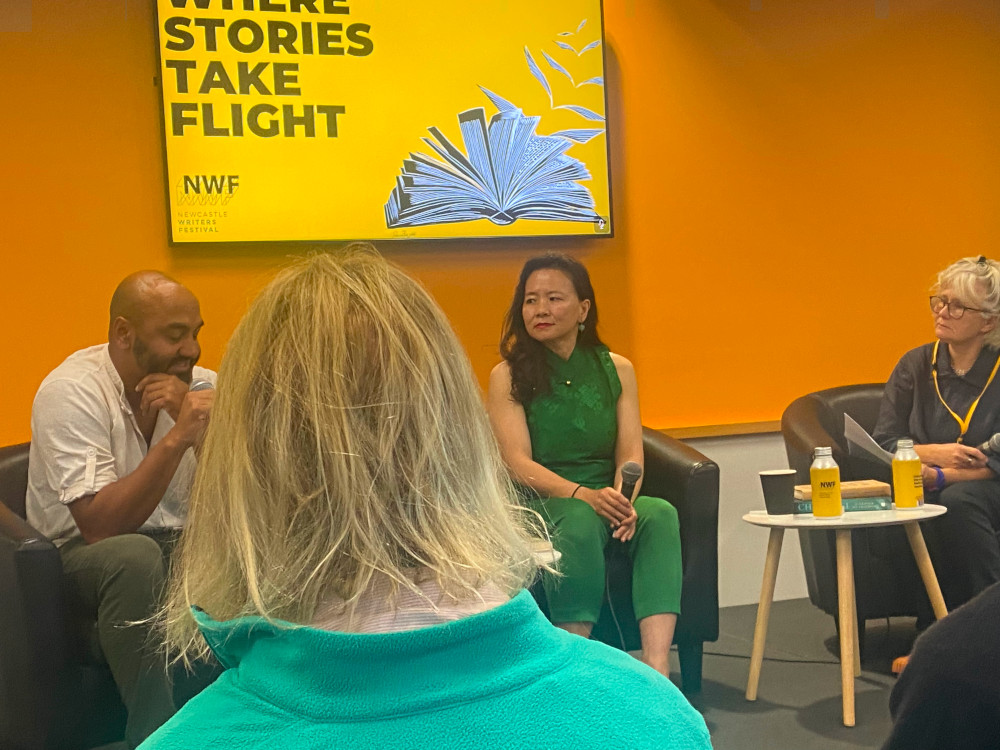
Playwright/author S. Shakthidaran, author/journalist Cheng Lei, discuss “The books that saved me” with writer/editor Ashley Hay.
###
Fontmania: Obadiah could not help it. As one session started, he reached for his phone. He just had to know the name of the font on the book festival slogan, “Where Stories take Flight.” It’s Monserrat, so close to Gotham – see the R, but different – see the G.
The lovely logo is by Rocco Fazzari, a colleague of Obadiah’s Fairfax days.
###
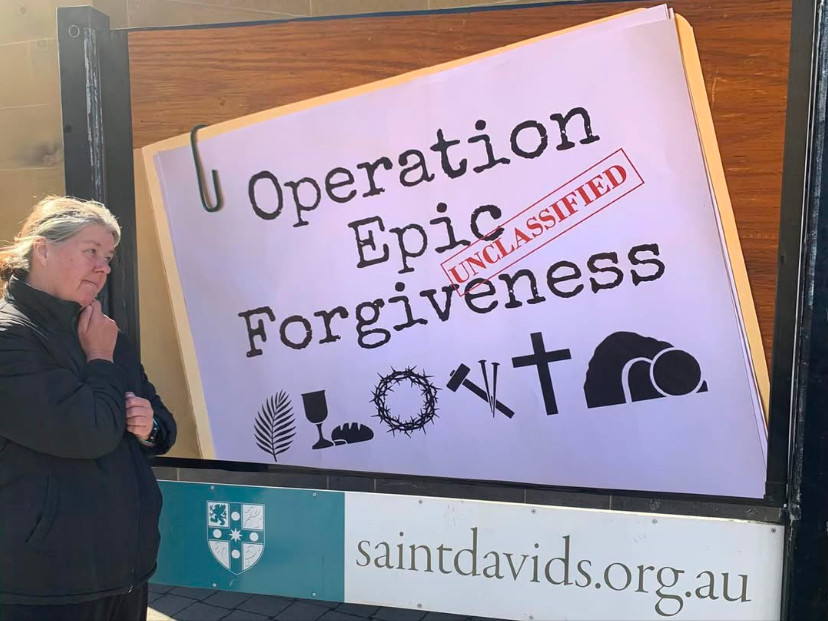
Epic: In a play on the US-led “Epic Fury” war, St Davids Cathedral in Hobart has adopted “Epic Forgiveness” as the meme of Easter.