
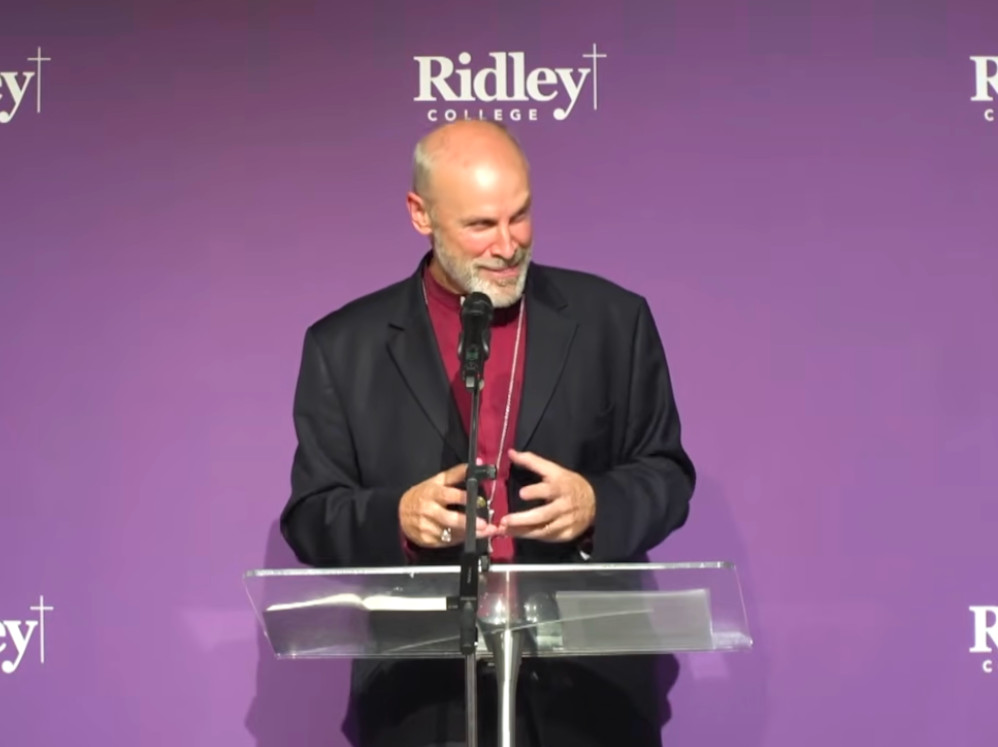
Melbourne’s Anglican Archbishop Ric Thorpe challenged his flock to grow thousands of leaders to grow the church in an address at Ridley College this month. The Archbishop’s 2026 Anglican Institute Lecture on Discernment and Partnerships: Renewal for the Diocese of Melbourne highlighted a plentiful harvest with too few workers.
The full lecture:
An excerpt:
Jesus went through all the towns and villages teaching in their synagogues, proclaiming the good news of the kingdom and healing every disease and sickness.
When he saw the crowds, he had compassion on them because they were harassed and helpless like sheep without a shepherd. And then he said to his disciples, “The harvest is plentiful, but the workers are few. Ask the Lord of the harvest, therefore, to send out workers into his harvest field.” Matthew 9:35–38
I think this passage of scripture is a passage for us in this moment in Melbourne. Let me just explore that a little bit. One of the emerging strands is that there are just so many opportunities that the church has to impact this place. Jesus’ words, “the harvest is plentiful.” I think he’s encouraging us to look up, to look up at the harvest. …
We are crowded out. We’re weighed down by the burdens of life, ministry and circumstances, but Jesus says, “Look up, the harvest is plentiful.” And this is so important for us to begin to see with Jesus’ eyes. There is a harvest of people who are ready to hear the gospel of Jesus Christ in Melbourne, Geelong and beyond, right now, but we cannot see it.
The harvest is plentiful. It’s massive. And Jesus’ analysis, I think, of our situation is that we’re not ready to respond to the harvest. It’s a message for every generation of the church because he knows. He knows what it’s like. We just don’t have enough people for that. We don’t have enough people for what we’re doing, let alone that. Isn’t that right?
Where are they going to come from, all these people? What the potential is – we can’t do it.
And yet Jesus is saying, “I’m inviting you to think differently about this.” So here’s the thing: you cannot do it the way you’re doing it right now. This is really hard for us to hear because we work really hard at what we’re doing. The workers are few, and it’s not anyone’s fault. It’s not a blame thing. It’s just a thing.
So the opportunity, well, let’s listen to Jesus. He says, “Let me find it.” He says, “Ask the Lord of the harvest, therefore to send out workers into his harvest field.” This is the most extraordinary opportunity we have. I’m going to use that word. You’re going to be bored with me saying “intentional”. We have to be intentional about praying for workers.
This is Jesus saying, “This is what we must do. ” And I think it’s one of the keys for us to address the opportunities of the harvest, is praying to the Lord of the harvest for him to send out workers…
It’s not necessarily for us to have more workers or for us to have more people, but actually it’s for people to be sent out into the harvest field.
But I’ve been a church leader, I know this. If only we had more workers, if only we had a bit more money to pay for workers, if only we had some of the right people, they’ve got loads of people. I wish we had some of them to come and help us. They’ve got too many people, and we’ve got too few if, if, if, if only.
And Jesus, I think he invites us to step into this gap between opportunity and what’s the reality, the harvest and our own situation. And that gap is the step of faith. That gap is the prayer of faith. It’s saying, “God, you want us to live in that space beyond our own current situation rather than living in our current space.”
Now, I’m not giving any easy answers here, but I just want us to hold that discomfort because I think Jesus is inviting us to pray out of that discomfort…
Prayer
Prayer through everything. We’re just hearing it again and again and again. It’s the number one thing in listening and lent. We want to have a diocese that’s praying. They’re saying, “We want our archbishop who’s going to lead prayer.” I’m really happy to do that, but all of us are caught up.
We want to be a prayerful diocese, prayer through everything. We’re to pray. We’re to learn to pray. We need to learn what to pray and we are to activate our prayers for workers in particular. Ask the Lord of the harvest to send out workers. And you know this better than me, but the surprise answer to the prayer that Jesus encourages his disciples to pray is, you are the answer to the prayers.
The numbers
In Matthew chapter 10, Jesus called his 12 disciples to him and gave them authority to drive out impure spirits and to heal every disease and sickness.
But let’s run the numbers for a moment. So your church has a small group of 10 people. There’s a leader, and maybe there’s an assistant leader or a training and apprentice leader. So it’s two out of 10. So that’s 20% of people already involved in leadership. There might be other people in the church who have other leadership roles in the PCC or whatever.
So let’s call it 25%. 25% of your church are already in leadership positions. So then, actually, if you want to take into account attrition, so some people might be getting older, some people might be finishing the race, some people might be moving cities. So maybe we need to train a few more. So let’s say it’s 30 or a bit more than 30% of people we need to be training, but then if we want to grow and if we want to plant, then we’re going to need more leaders.
So we started thinking about this in our church in Shadwell in East London, and we realised that we needed to be training40% of our church. We were a church-planting church, so we needed to train 40% of our people in leadership development of some kind or another..
There are 17,000 people in this diocese. Can someone run the maths on 40% of 17,000? Thank you. So 6,800. We need 6,800 leaders in our churches to just keep going at the moment. And I would say we’re probably nowhere near that at the moment. I haven’t run those numbers yet, but I think we know that instinctively.
So there’s a huge opportunity to up our game. We need theological colleges to step in and partner with the diocese in a new way to say, actually, how are we going to increase the flow of people being trained theologically and deeply in this way?
… The scriptures, I think, address this need. I often go back to Jethro’s advice to Moses in Exodus 18 or Paul’s advice to Timothy and 2 Timothy chapter 2. Both talk about the need to develop leaders, both talk about skills that need to be imparted and character that needs to be formed. Good character must be formed, and it must be formed early. I [have] encountered too many people where there is a character flaw that is emerging in later ministry.
And one of the issues is that underneath that flaw, you can never teach into that flaw, say it’s anger. You can’t teach on anger ever because you either can’t see it or you don’t have the right to speak about it. And there are a lot of anger issues that are not dealt with because of that. That’s because a character flaw wasn’t addressed early on. It’s much easier to address these things early on.
And so we need to be really leaning into character development of formation of people and that’s going on already, which is wonderful. I just want to say we need to keep on leaning into that, but for this kind of breadth, but also skills. Skills need to be taught throughout ministry…
How do we train church planters? How do we train teachers in the church? How do we equip the whole church, the 6,800 who are going to need equipping, so that they can pass on their skills to other people? So this is where’s the place whereleaders learn how to break through glass ceilings in churches?
So if a church stays at around 40 or 50 people, actually, you can break through that if you are trained how to do it. And it’s often not about something spiritual, it’s about the skill of the leader themselves and the context in which they need to read that situation. And it’s not on that person. There are glass ceilings at 50, 100, 120, 180 to 200, 200 to 400, 400, to 800. They all involve different ways to lead. And we have to impart that training so that people can learn either how to manage in a particular level, an appropriate level, or to take a church that we feel has the potential to grow in a particular place. …
So we know we need them, but what kind do we need? And I believe there are broadly three groups of people that might fit into this need. First of all, we need clergy who are fit for mission. Secondly, we need lay leaders, authorised lay leaders as well, who play their part in multiplying ministry in the church, in evangelism, in disciple making and developing leaders. And we need lay people who are sent into the world to pray your kingdom come in every walk and sector of life, in schools, in hospitals, in banks, in train driver cabbies, amongst carers, gardeners, full-time parents, whatever the place God has called us to be in. We need to be equipped to say, Lord, your kingdom come here. And how can we as a church release those people, send those people to be confident disciples and leaders in their contexts? …
This is about sending people into the world. And I know you know this, but how do we equip people in those words at the end of a service where we say, “Go in peace and love and serve the Lord.” How are we doing that?
What are the ways we’re equipping people? And I think there’s the potential to look at that gap that I think is often there to say, what does it mean for people who are influencing their offices, their places of work in various settings, schools, [there’s] a huge opportunity to influence in schools. How do we equip people for those places intentionally? How do we help them to reflect theologically on their own calling and the work that they’re called to do, not just thinking vocation into ministry in the church, but ministry in the world? How do we help them shape a Christian worldview for the church? And again, in this context, I want to say to theological colleges, we need you to help us with thought leadership.
You’ve got the theologians in your midst. You’ve got the thinkers, you’ve got the space and time to be able to go, let’s look at some of these really challenging subjects.
What about freedom of speech? That’s a major deal in Australia at the moment. We’ve got the answers to that. Christendom is behind freedom of speech, and yet I’m not hearing us. Maybe it’s me, I don’t know, but we need to be thinking [about] how we equip the church for this space? Immigration is a major [issue] at the moment. The development of this city, town planning, you’ve got major problems. I’m a Melbournian now. We’ve got major problems in the next 25 years because the city has not been well planned. What do we have to say about that?
Gender identity is a massive issue, but at the moment, we’re not having good discussions and conversations about it from different sides of the argument to say, actually, what is a view that we can say as the church, where there are different views, but actually, that we are known for our love for one another and known for those who are struggling with our identities.
Just war. Oh my goodness. Talk about a minefield. Just war is about what you go into, why you go into a war, but also how you sustain it, how you behave inside it and equally how you come out of it. When you think about whether a war is just, you think about the end and coming out of it as much as the beginning. These are just massive ethical issues that we need you. We need you colleges to be thinking about this and leading the way in thought leadership.
Let me just riff on that space a little bit as well. An observation of mine is that the only place we have theological debate across the breadth of the church is in Synod [Church parliament]
And I’ve had the great fortune of not having been in one of your Synods yet, but that Synod is the only place at the moment you have for theological debate across divides and Synods, I have to say, is not the place for this kind of thing. It is set up for parliamentary-style debate and argument rather than having the chance to wrestle together over a longer and more considered period of time.
Previous Synods, going back in history, took weeks and months, because they did have the time and gave the time to wrestle with theological things. And by the way, even when they met, sometimes it took centuries for them to work it out.
Now, I know social media has kind of sped things up a bit, but we need to give ourselves some grace in actually providing other places for us to do that. And so with Ridley [College] and Trinity [College] in the room as starters, I want to encourage you, let’s find some spaces where we can have those loving conversations where we have the chance to listen to each other and the chance to work through things and explore what are the weaknesses in our positions, but also the opportunities of finding common ground, but also reasoned positions that might well be very, very different.
If you’ve got those three areas, clergy, lay leaders for ministry and lay leaders sent into the world, I think there’s a strand that might feed all three of those that we need to boost up as well, and that’s apprenticeships. This is about feeders into those three areas of leaders and creating opportunities for them. Some churches have various opportunities in this area, for apprentices. Rhys [Bezzant, the Ridley College Principal] kindly introduced me to some of the different language around this, but perhaps, apprentices might be more associated with campus groups, trainees might be associated with some churches, interns with others.
In a way, I’m talking about the whole kaboodle, that kind of great word and just say, this is an opportunity to develop people when they’re younger, as they think about going into some kind of vocation, even into the world. And there are different opportunities, different expectations of this, and many of those apprenticeship years involve study in your colleges.
So for that, I thank you. But I also think there’s an opportunity here in order to meet the needs of the harvest that God has before us in Melbourne and Geelong and in this diocese, apprenticeships are going to supercharge vocation and ministry.
And if they’re framed right, they help those people to discern the nature and direction of their own vocation because we need people not just in the church. We do need people in the world to be equipped and sent into that place. So you’re already training people and forming people for mission, both here in this college and Trinity [College] and in our churches. You’re doing this, but my invitation is to ensure that you are forming disciples for today’s mission and tomorrow’s mission, and it is changing fast. We need to be thinking ahead rather than just looking back at what worked before. So my invitation to everyone in this room and those online is, how can we do this in partnership together?
Image: Archbishop Ric Thorpe delivers the 2026 Anglican Institute Lecture on Discernment and Partnerships: Renewal for the Diocese of Melbourne. Image Credit: screenshot from Ridleyy College video